

Where Bright Ideas
Come to Life!
Come to Life!
If you've ever had an electrician round and heard the words "ring final circuit" or "radial circuit" and nodded along without really knowing what it meant, you're in good company. Most homeowners never need to think about it — until something trips, a socket runs warm, or you're trying to work out why the kettle keeps blowing a fuse but the toaster next to it doesn't.
I get asked some version of this question most weeks, usually after someone's read something online, or a landlord's had an EICR come back with an observation they don't understand. So let's settle it properly.
Short answer first, because I know you're busy: both ring and radial socket circuits can be perfectly safe for your appliances when they're installed correctly and used sensibly. Neither one is "the safe one" and the other "the risky one." What matters more is how the circuit's protection is coordinated, how it copes with a fault, and — more than either of those — whether the right fuse is sitting in the plug on the end of your appliance. I'll walk through all of it below, because the detail is genuinely useful if you own a home, let a property, or run a business with staff plugging things in all day.
Before I go any further, I want to clear up something I hear on the phone almost every week: "my ring lighting circuit has tripped." There's no such thing, in the vast majority of homes — lighting circuits are radials, not rings.
Lighting circuits run on much smaller cable, typically 1mm² or 1.5mm², protected by a 6A breaker, because lights draw a fraction of the current sockets do. Wiring that as a ring would be unnecessary and, on such thin cable, would actually work against the safety logic I've been describing throughout this article — there's no benefit to a loop when the loads are this small, and it just adds another set of joints that could fail. So a standard lighting circuit — the one running your ceiling roses, pendant switches, downlights — is a radial, full stop. If a customer tells me their "ring circuit" has gone on the lights, what's usually happened is a breaker's tripped, or a bulb's failed and taken a shared neutral with it, not anything to do with a ring at all.
There is one genuine exception, and it's worth understanding because it does involve a ring, just not in the way people assume. Where a property's been extended — a conservatory, a garage conversion, sometimes outdoor lighting — and there's no way of running a dedicated lighting cable back to the consumer unit without a disproportionate amount of chasing, drilling, or disruption, it's common practice to power that lighting from the nearest ring final circuit via a fused spur or switched fused spur. In that case, the lighting itself is still functioning as a radial arrangement from the spur outward, but the spur is drawing its supply from a socket ring rather than from a dedicated lighting circuit and its own breaker at the board.
This is exactly the scenario covered in What Fuse Do I Use in a Fused Spur? — you'll typically find a 3A or 5A fuse in the spur feeding that lighting, sized to the number of light fittings on it, not a 13A fuse, because 13A would offer no meaningful protection to lighting cable and flex rated for a much smaller load. I've seen this done properly and safely more times than not, but I've also seen it done as a shortcut where the spur's been fitted with whatever fuse was to hand rather than one calculated for the actual lighting load — which brings us straight back to the plug-fuse principle from earlier in this article, just applied to a fused spur instead of a plug.
If you're not sure whether your conservatory or garage lighting is on its own circuit or fed off a ring via a spur, that's a five-minute check for one of my team next time we're on site, and it's worth knowing either way — particularly if you're planning further extension work and assuming there's spare capacity that a shared ring-fed spur may not actually have.
A ring final circuit does exactly what it sounds like — it's a loop. The cable leaves your consumer unit, runs round to every socket on that circuit, and comes back to the same breaker. Because it's a loop, current can reach any socket from two directions at once. In a typical UK home, that's 2.5mm² cable protected by a 32A MCB or RCBO, feeding a room or a few rooms' worth of BS 1363 sockets — the standard three-pin type you've got in every wall.
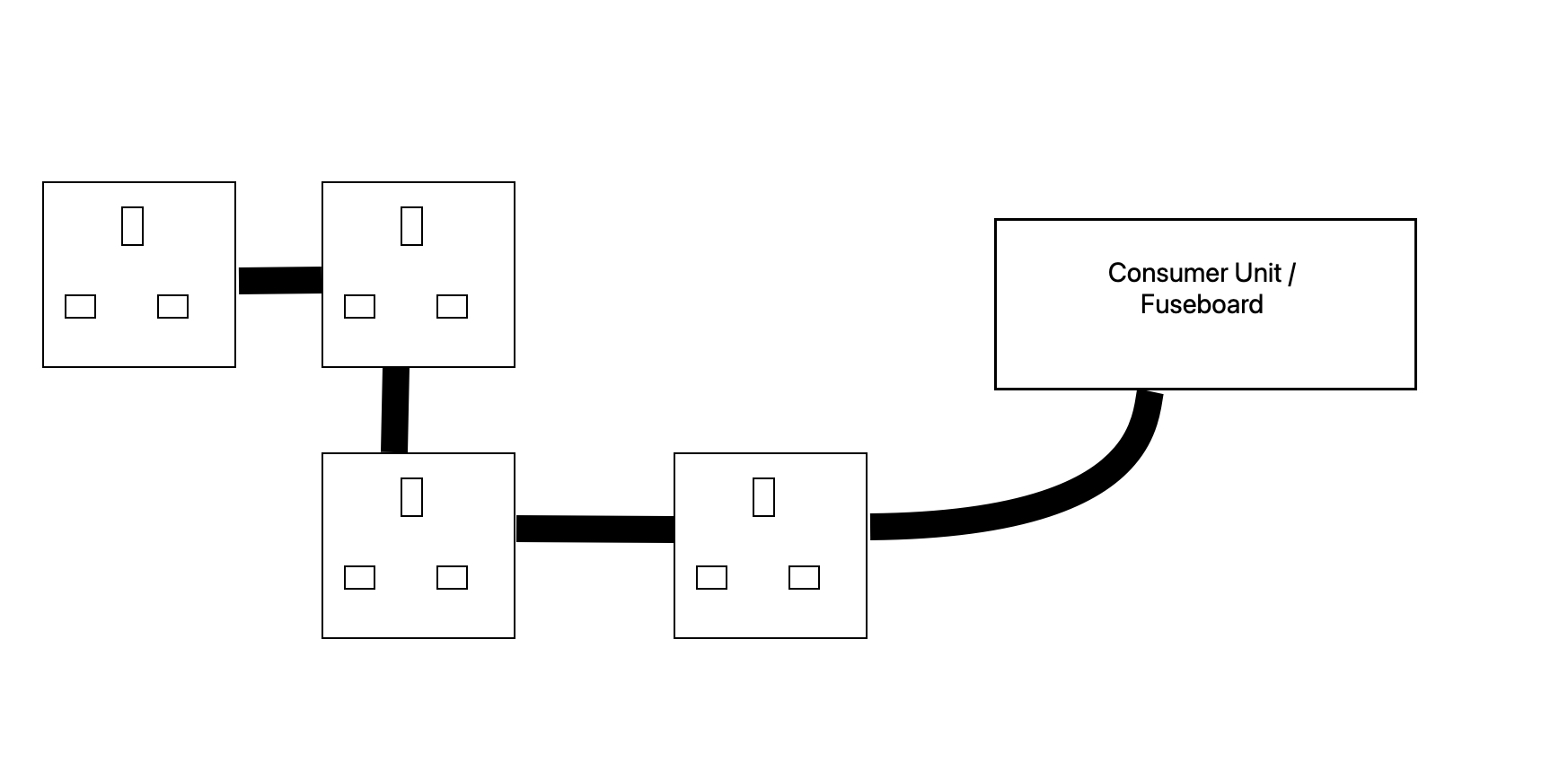
A radial circuit is simpler: one cable leaves the board, runs to the first socket, continues to the next, and so on, ending at the last one. There's no loop back to the breaker. Depending on the cable size, a radial might be protected by a 20A breaker on 2.5mm² cable, or a 32A breaker on 4mm² cable.
Both are recognised under BS 7671 (the UK Wiring Regulations), and both are common. Older properties across Tunbridge Wells and the surrounding villages tend to have rings from the days when copper was expensive and a loop meant you could use thinner cable to cover a bigger area. Newer installations, extensions, and dedicated circuits for specific appliances increasingly use radials because they're more straightforward to design, test, and fault-find.
Neither is inherently the "better" or "worse" choice — but they behave differently when something goes wrong, and that's where appliance safety comes in.

Here's the bit most people get wrong: with standard UK sockets, it's the plug fuse doing the heavy lifting for appliance protection, not the ring or the radial.
Every appliance plugged into a BS 1363 socket has a BS 1362 fuse sitting inside the plug — usually 3A or 13A. The 32A (or 20A) breaker at your consumer unit is there to protect the fixed wiring in your walls from overheating. The plug fuse is there to protect the flexible cord running from the plug to your appliance, and the appliance itself, from a much smaller fault current than the breaker would ever notice.
Think of it like a building with a big water main and a small tap. The main can handle far more flow than the tap was ever designed for. If the tap fails, you don't want to be relying on the main's much higher capacity to protect it — you want something sized specifically for the tap. That's what the plug fuse is doing for your appliance's flex.
So whether your kettle is on a ring or a radial makes almost no difference to how well it's protected against an internal fault — what matters is whether there's a 3A fuse in a lamp that should have one, rather than someone's grabbed whatever fuse was lying in the drawer.
If you're not sure what should be in a plug, I've got a straightforward breakdown here: Which Fuse Do I Use?

I don't want to oversell the "it's all about the plug fuse" point, because there are real differences between the two circuit types that matter in certain situations.
Fault disconnection speed. A ring has two parallel paths back to the breaker, which usually gives it a lower earth-fault loop impedance than a radial of similar length. In plain terms, that means when there's a genuine short or an earth fault, more current tends to flow, and the breaker trips faster. That's a real, measurable safety margin. However, modern regulations expect 30mA RCD or RCBO protection on socket circuits regardless of ring or radial, and that dominates shock protection for most fault scenarios — so this advantage is smaller than it used to be before RCD protection was standard.
Tolerance to hidden wiring faults. This is the one I'd flag hardest to any homeowner or landlord with an older property. A ring circuit depends on its continuity — the loop being intact at every joint, all the way round. If a connection fails somewhere (a loose terminal, a rodent-damaged cable, a botched DIY alteration years ago), the ring doesn't necessarily stop working. It can quietly become two long radial "arms" still sitting on a 32A breaker that was only ever sized correctly for a full loop. Under heavy loading, that section of cable can run hot without ever tripping the protective device, because the breaker still sees the load as within its rating. This is a genuinely dangerous failure mode, and it's invisible unless someone tests for it. A radial doesn't have this hidden parallel path to lose in the first place, so what you see is generally what you get — if something's wrong, it tends to show up as an obvious fault rather than a silent one.

Heat at terminations. On a ring, a loose connection at a socket or joint box can still "work" from the user's point of view — lights come on, the kettle boils — while carrying a disproportionate share of the ring's current and running hot behind the faceplate. I've pulled apart more than a few sockets over the years that looked completely normal from the front but had scorching on the terminals behind. On a radial, a bad joint is usually more obvious because things downstream simply stop working, though a loose connection can still overheat before it fails completely.
Earth continuity. Rings typically have a ringed circuit protective conductor (CPC), giving two earth paths to every point on the circuit and generally a lower earth fault loop impedance. That's a genuine safety benefit — provided the ring is actually intact, which loops back to the point above about hidden breaks. Radials have a single earth path, which is simpler to inspect and test, if slightly less resilient in principle.
Load concentration. A ring can comfortably support a spread of moderate loads across a room — lamps, a TV, phone chargers, that sort of thing. What it can't safely do is absorb everyone's expectation that "it's a ring, it can take anything." I still see multi-way adaptors stacked with heaters, and that's a fire risk on any circuit type, ring or radial. A 32A 4mm² radial behaves much like a ring under load; a 20A 2.5mm² radial will generally reach its limit and trip sooner under concentrated heavy use, which — while inconvenient — is arguably the circuit doing exactly what it should.
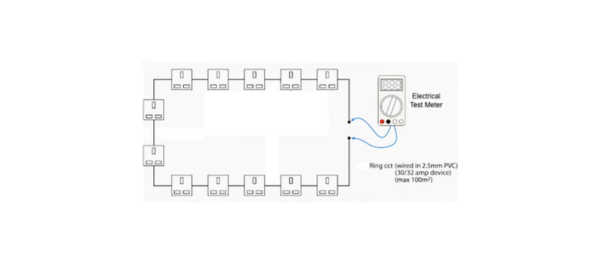
It's one thing to explain this in theory. It's another to see what it actually looks like when I open up a consumer unit or pull a socket off the wall in a property that's twenty, thirty, forty years old.
The ring fault I come across most often isn't dramatic. It's a socket that was changed at some point — maybe when a kitchen was fitted, maybe by a previous owner doing their own DIY — where the outgoing conductor wasn't properly reconnected into the loop. Everything still works. The customer's never noticed a thing. It's only when I do a proper ring continuity test, checking end-to-end resistance on line, neutral and earth, that it shows up as a break. In one Tunbridge Wells property I tested a couple of years back, half the ring in the lounge had effectively been running as an 18-metre radial arm on a 32A breaker for what was probably a decade. Nothing had ever tripped. Nothing had ever felt warm. It was pure luck that nothing heavier than a lamp and a TV had ever been plugged in at the far end.
That's the pattern with ring faults — they tend to be silent until load and time combine to make them not silent anymore. It's exactly why I don't take "it's working fine" as evidence a ring is sound. Working and safe aren't always the same statement.
Radial faults tend to announce themselves differently. When a joint fails on a radial, everything downstream of that joint typically loses power outright, because there's no second path for current to take. It's inconvenient, sometimes at an awkward time, but it's obvious — which from a safety point of view is actually the more forgiving failure mode. A circuit that fails loudly gets fixed. A circuit that fails silently doesn't, until someone goes looking for it.
None of this means rings are a bad choice — plenty of the properties I maintain have had rings running safely and correctly for decades, because they've been tested properly and any alteration work has been done and verified to standard. It's unsupervised alteration over time, on either circuit type but particularly on rings, that creates the risk.
For most owner-occupied domestic properties, the accepted guidance is an EICR every 10 years, or at change of occupancy if sooner. For rental properties, it's a legal requirement in England for landlords to have a valid EICR at least every five years, and that inspection has to explicitly confirm things like ring continuity, not just that sockets appear to be live.
Commercial premises, and particularly care settings, should generally be tested more frequently than that — often every five years as a default, sometimes more often depending on the environment, the age of the installation, and how much equipment is being plugged in and unplugged day to day. A commercial kitchen or a care home with mobility equipment, hoists, and monitoring devices constantly being connected and disconnected puts far more mechanical wear on sockets and flexes than a typical living room ever will, and that wear is exactly where the terminations I mentioned earlier start to loosen.
If you manage a property portfolio or a commercial site and you're not sure when the last full test was done, or what it actually covered, that's worth chasing down before it becomes someone else's emergency call-out.
This one catches people out more than almost anything else I see on site visits. If you've bought an appliance abroad — say, from a country using the Schuko-style unfused two-pin system common across much of Europe — and you're running it through a simple adaptor into a UK socket rather than a proper UK-fused plug, you've potentially removed the one piece of protection sized specifically for that appliance's flex.
Those appliances are designed on the assumption that their home circuit is protected differently, often at 16A, with the appliance's internal design and cord accounting for that. Bring one into a UK ring or radial via a basic adaptor with no fuse of its own, and that thin flex can be sitting behind 20A or 32A of protection with nothing appropriately sized in between. It'll probably be fine 99 times out of 100. It's the hundredth time — a chafed cord, a failed component — that turns into an overheated flex or a fire.
The fix is simple: only use fused travel adaptors, or better, have the appliance properly replugged with a correct BS 1363 fused plug sized to the load.
Yes, and this is worth flagging particularly for the kitchen and bathroom installers and suppliers I work with regularly. Big fixed loads — electric cookers, tumble dryers, EV charge points — should be on their own radial circuits with breakers sized correctly for that specific load, not connected onto a general-purpose ring alongside the toaster and phone chargers. A fused connection unit (FCU) can safely spur a fixed appliance up to 13A off a ring, which covers things like an integrated dishwasher or washing machine, but anything beyond that needs its own circuit from the board.
If you're planning a kitchen refit or an EV charger installation, this is exactly the kind of thing that should be designed in from the start rather than retrofitted onto whatever circuit happens to be nearest. I've covered the groundwork for bigger jobs like this in the Rewiring Your Home section if you want the wider context.
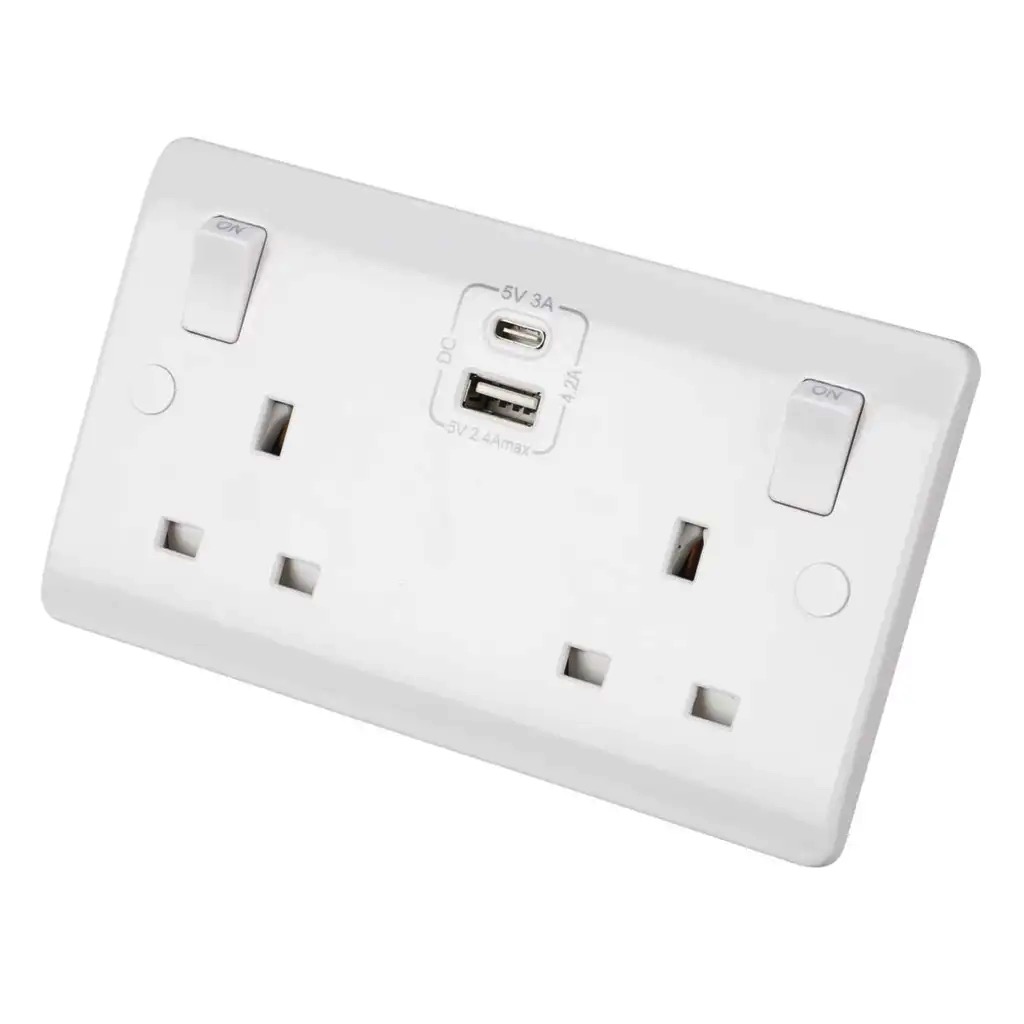
Honestly, for day-to-day appliance and shock safety — yes, in most modern homes, the RCD or RCBO protecting the circuit is doing more of the practical safety work than the ring-vs-radial choice ever will. A 30mA RCD is designed to disconnect fast enough to prevent a dangerous shock well before the breaker's overcurrent protection would even engage, and it applies equally whether the circuit behind it is a ring or a radial.
Where I'd steer clients — particularly landlords and commercial premises with multiple circuits — is towards RCBOs rather than a single RCD covering several circuits. An RCBO combines the overcurrent protection and the RCD function for one circuit only, so a fault on one appliance trips just that circuit rather than taking out half the property. For a care home or a business that can't afford lights and equipment going off across multiple rooms because of one faulty kettle, that distinction matters a great deal more than which topology the sockets are wired in.
If you're managing a rental property, a shop, or a care setting, you don't need to become an expert in circuit topology — that's what your EICR is for. But there are two things worth knowing:
An EICR should identify whether ring circuits are actually continuous, not just whether they appear to work. A ring that's silently become two radials on an oversized breaker is exactly the kind of latent fault a proper test picks up and a visual inspection won't. If you've had EICRs come back clean year after year on an older building, that's genuinely reassuring — it means the testing is catching what needs catching.
Second, the consequences of getting this wrong scale with occupancy and equipment density. A single domestic ring with one overloaded extension lead is a bad night. The same fault pattern in a care home corridor, or a commercial kitchen running multiple pieces of equipment off ageing sockets, is a much bigger liability. If you're responsible for a property where I haven't done the last EICR, it's worth asking your current electrician directly whether ring continuity was tested and confirmed, not just assumed.
More on what a proper test actually covers here: Electrical Testing
Signs of a Socket Circuit Problem You Shouldn't Ignore
A socket or plug that feels warm to the touch, even faintly, especially under normal load. Discolouration around a socket faceplate — that's heat damage, and it doesn't un-happen on its own. A breaker that trips only occasionally and only under certain combinations of appliances, which can point to a marginal fault rather than a straightforward overload. And on older properties, any sign that sockets have been added or altered over the years without proper testing afterwards — that's exactly where hidden ring breaks tend to originate.
None of these are "wait and see" situations. If you're noticing any of them, get it looked at before it becomes a Help! No Electricity situation, or worse.
For a general-purpose socket circuit in a typical room, both are valid choices under BS 7671, and honestly, the decision often comes down to what suits the building's layout and existing infrastructure better than one being objectively superior. Where I lean towards radials more often these days is exactly because of that hidden-fault tolerance point — a radial's simplicity means less can go quietly wrong with it over a 20- or 30-year lifespan, and it's more straightforward to test and fault-find years down the line, which matters if you won't be the one maintaining it.
Where I'd always specify a dedicated radial without hesitation is for anything with a significant or continuous load — cookers, EV chargers, dryers, immersion heaters, anything of that nature. And regardless of which topology you choose for general sockets, RCBO protection per circuit is the single upgrade that does the most for appliance and occupant safety.
One pattern I see repeatedly on commercial visits, and one that deserves its own mention because it undoes a lot of otherwise good circuit design: staff plugging multi-way extension blocks into a single socket and then running several pieces of equipment off it permanently, rather than treating it as the temporary measure it's meant to be. Printers, chargers, kettles, and space heaters all sharing one 13A fused plug is a common sight in offices, and in care settings it's often monitoring equipment, hoists on charge, and personal care devices all competing for the same outlet.

It doesn't matter how well-specified the ring or radial behind that socket is if the load concentrated at the socket itself exceeds what the extension and its fuse were designed for. This is a training and facilities-management issue as much as an electrical one — the fix usually isn't a bigger circuit, it's more socket outlets in the right places so staff aren't forced into daisy-chaining in the first place. If you're a facilities manager reading this and recognising the pattern, that's worth raising as a straightforward, low-cost improvement rather than waiting for it to show up as an EICR observation.
A handful of things make a bigger practical difference than ring vs radial ever will. Fit the correct BS 1362 fuse for the appliance — 3A for lamps and small electronics, 13A for high-draw items like kettles and heaters, rather than defaulting to 13A for everything. Only use fused adaptors for imported or travel appliances. Avoid daisy-chaining multi-way adaptors, and keep the total load on any extension lead within its rating — our Socket Overload Calculator is a quick way to check if you're not sure. Test your RCDs periodically using the built-in test button. And if a plug or socket ever feels warm or looks discoloured, treat that as a fault, not a quirk.
With standard UK BS 1363 sockets, appliance safety comes down more to correct plug fusing, sound terminations, and proper RCD protection than to whether your sockets are wired as a ring or a radial. Rings offer good capacity and, when intact, strong fault disconnection performance — but they're less forgiving of poor workmanship or unrecorded alterations over the years, and they rely on periodic testing to confirm that "working" and "actually safe" are the same thing. Radials are simpler to design, test, and fault-find, and they're the right choice for dedicated, high-current appliances every time.
Whichever your property has, the fundamentals stay the same: the correct fuse in the plug, no overloaded adaptors, and RCD protection you can actually rely on. If you're not sure what you've got, or when your circuits were last properly tested, that's exactly what an EICR is for — get in touch and we'll tell you straight what's there and what, if anything, needs doing.
No. Neither is inherently more dangerous when correctly installed, tested, and maintained. Rings can be less tolerant of hidden wiring faults developing over time, while radials are simpler to fault-find, but both are recognised as safe under BS 7671 when properly specified and protected.
No. The plug fuse is sized to the appliance and its flexible cord, not to the circuit type. A 3A or 13A BS 1362 fuse choice is the same whether the socket is on a ring or a radial.
A hidden break in a ring can leave part of the circuit acting as a long radial still protected by the original ring-rated breaker, which may allow that section of cable to run hotter than intended without tripping. This is why periodic testing of ring continuity matters.
Fixed high-current appliances like cookers and ovens should always be on their own dedicated radial circuit sized to the load, not connected to a general-purpose ring.
Yes. Ring circuits do not provide the fast-acting shock protection an RCD offers. Current regulations expect 30mA RCD or RCBO protection on socket circuits regardless of whether they're wired as a ring or a radial.
Ring continuity is confirmed through proper electrical testing, typically as part of an EICR. It cannot be reliably assessed by visual inspection alone, since a broken ring can continue to appear to function normally.
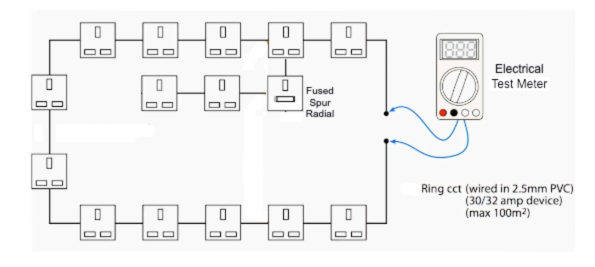
No, almost all UK lighting circuits are radials, wired on thin cable protected by a 6A breaker. The exception is extension lighting — such as a conservatory, garage, or outdoor lighting — that's sometimes powered from a socket ring via a fused spur where running a dedicated lighting cable isn't practical.
To make contact and discuss further for a Bright Spark Electrician, fill out our simple form to provide you with further information or even visit you should issues have arisen for your home. [Click this Link]
For further Information, please do not hesitate to contact us.
Telephone: 01892 531728
I've used Electricians from Bright Spark 3 times to date , inc. a for a test certificate prior to buying my property. At all times the Electricians have provided a first class service with easy to understand advice and the work completed to a high standard. Many thanks to Karen and the Team.SC
We are very pleased with the high standard of the recent work carried out by Bright Spark and would happily recommend the service. We were particularly impressed by the quick response to our online enquiry and the email follow up by Karen after the job had been completed. We will definitely use her for any electrical job in the future.
I had no electricity and phoned up in very late evening. Karen phoned me back despite it being late evening and sorted out my problem on the phone . Great service, extremely helpful and quick response and I didn’t even have to pay for a visit. Thoroughly recommend this company and will definitely use them again.
The two guys from Bright Sparks arrived promptly as arranged. Took their outdoor boots off before making their way to the job - a nice touch . Efficient, pleasant; I could not have asked for more. When the invoice arrived I was also pleasantly surprised. Overall a good experience 10/10
Just to say a big thank you for the work that your electrician carried out at my mothers house. He was very professional and a clean worker and the finished job was a complete success. It is very comforting to know that when a tradesperson attends the property of a elderly customer that they feel safe and happy. Once again, Thanks Keith


