

Where Bright Ideas
Come to Life!
Come to Life!
Open the cupboard, look at what's inside, and I can usually tell you in under a minute whether it needs changing. You can do most of that assessment yourself before you even call anyone. Here's what I'm looking for.
Three things send me straight to "yes, this needs changing":
A wooden back board. If the board is mounted on wood rather than a metal or fire-resistant enclosure, it predates modern fire safety requirements by decades. These often date back to the 1950s-60s and don't meet current standards, full stop — no adaptation makes a wooden-backed board compliant.
No RCD protection anywhere. If nothing on that board trips on an earth fault — just old-style fuses or breakers with no residual current device — you've got no protection against electric shock from a faulty appliance or damaged cable. That's the single biggest reason I recommend a change.
Rewireable fuses. If something trips and your fix involves rewiring a fuse with fuse wire, or driving to a wholesaler for a replacement cartridge, that's a fuse board, not a consumer unit. It'll usually be labelled BS 3036. Circuits protected this way don't disconnect anywhere near fast enough in a fault.
If your board has any one of those, it needs replacing. If it's got all three, don't wait for a problem to force the issue.
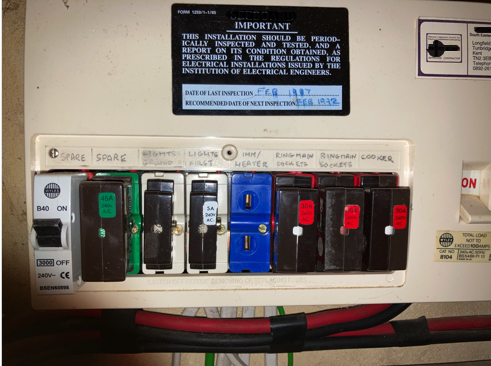
Under BS 7671:2018+A4:2026 — the current wiring regulations as of April 2026 — RCD protection is required for the vast majority of domestic circuits, including sockets, lighting, and anything supplying a bathroom or outdoor space. A board with no RCD protection at all, or with only some circuits covered, doesn't meet the current standard. That doesn't automatically mean the whole board comes out — sometimes we can add protection to specific circuits — but if the existing board can't physically accommodate RCBOs, or the manufacturer's stopped making parts for it, a full replacement is usually the more sensible route than patching.
Not necessarily. Plenty of boards from the 80s and 90s have MCBs (miniature circuit breakers) instead of rewireable fuses, which is an improvement, but if there's still no RCD protection behind them, you've got the same shock risk as an old fuse board — it just resets with a switch instead of a fuse wire. I see this a lot: people assume "it's got breakers, not fuses" means it's modern. The breaker protects the cable from overload. It does nothing for you if you touch a live faulty appliance.
Age and condition matter more than the label. Signs I look for on site: scorch marks or discolouration around the board, a smell of hot plastic, breakers or fuse carriers that feel warm to the touch, or a board that's had bits added and adapted over the years by different people. Any of those move a board from "due an upgrade" to "needs looking at now." If you're seeing or smelling any of this, don't wait for a scheduled visit — get in touch.
Very common call. If you've moved into a property and found an old-style board under the stairs, it's worth having it looked at before you assume it's fine just because "it's always worked." An EICR (Electrical Installation Condition Report) will give you a proper coded assessment — see our Electrical Testing page for what that involves — and tell you exactly where the installation stands against current regs, not just the board.
Yes, and it carries more weight for you than for an owner-occupier. Landlords have a legal duty of care to tenants, and an EICR is a required part of that. If a tenant reports a trip, a smell, or a fault and it traces back to an old board with no RCD protection, that's a liability sitting in your property, not just an inconvenience. Getting ahead of it — rather than reacting to a tenant complaint or an EICR failure — is the cheaper and lower-stress route in the long run.
Two reasons this comes up. First, the original manufacturer may have stopped trading or stopped making parts, so even a straightforward RCD add-on isn't possible — the whole board has to go. Second, regulations move faster than most people expect. A board that was fully compliant when fitted ten or fifteen years ago can fall short of current requirements now. That's not a sales pitch — it's the same conclusion an EICR reaches, and it's worth reading our page on the difference between a fuse board and a consumer unit if you're not sure which one you've got.
Nothing happens immediately in most cases — that's exactly what makes old boards easy to ignore. The risk sits quietly until there's a fault, and then the lack of RCD protection is the difference between a circuit tripping safely and someone getting a shock. For landlords and anyone selling, it also shows up as a fail point on an EICR or a red flag for insurers and mortgage lenders, which tends to surface at the worst possible time — mid-sale or mid-tenancy.
Send us a photo of your board — close up and from a bit further back, showing the meter alongside it if you can — and we'll tell you honestly whether it needs a full replacement or just a targeted upgrade. If you want a fixed price, our fuse board upgrade costs page covers what most jobs actually cost, and how long a board change takes if you're planning around it. Phillip, our NICEIC Qualified Supervisor, signs off every certificate personally.
We cover Tonbridge, Tunbridge Wells, Sevenoaks, Crowborough and the surrounding areas. Call 01892 531 728, WhatsApp 07775 561 363, or email karen@brightsparkelectrician.co.uk.
Check for a wooden back panel, absence of RCD protection, and rewireable fuses (BS 3036). Any one of these means it needs replacing.
Yes. Wooden-backed boards predate current fire safety standards and typically date to the 1950s-60s. They should always be replaced, not adapted.
Sometimes, if the existing board can physically accommodate it and parts are still available. Often the manufacturer has stopped trading or the board can't take the upgrade, meaning a full replacement is needed.
Landlords have a legal duty of care to tenants, which an EICR assesses. A board without RCD protection is likely to fail that assessment and should be addressed proactively.
Not on its own. Breakers protect against overload, not electric shock. Without RCD protection behind them, the shock risk is the same as an old fuse board.
Please do not hesitate to contact us.
Telephone: 01892 531728
Email: karen@brightsparkelectrician.co.uk
I have always found Karen and her team at Bright Spark to be friendly, professional and reliable. Their quotes have been reasonably priced and provide a thorough breakdown of costs for replacements parts and labour. I highly recommend them.
I needed a job done really 'sooner rather than later' and at a weekend too! Karen came out, assessed what needed to be done and set to work straight away. Job done, cleared up and on her way within the hour! Not often you get that service! Certainly will keep her number on my mobile and recommend to anyone who needs an electrical job done!
I had no electricity and phoned up in very late evening. Karen phoned me back despite it being late evening and sorted out my problem on the phone . Great service, extremely helpful and quick response and I didn’t even have to pay for a visit. Thoroughly recommend this company and will definitely use them again.
Karen runs a great company. She is that very rare breed of taking care, respecting and rewarding her employees. In turn, Terry who carried out our work showed due care and attention and completed works with such professionalism. He interacted with my inquisitive little boy who may, one day may, become an electrician - he certainly had a great role.model to follow!
Karen and her team of electricians did a very good job in assessing our electrical circuits, modernising and upgrading our fuse boxes and ensuring compliance with the latest regulations. They were efficient and polite and, when they had finished the work, left the house tidy and in good condition


