

Where Bright Ideas
Come to Life!
Come to Life!
An electrical surge is a sudden spike in voltage that lasts a fraction of a second but can be enough to damage anything plugged in at the time. There are two main causes.
Lightning strikes are the big one. A direct or nearby strike can push voltages up to 6,000V through a property's wiring, and the effects can travel through the network for up to a kilometre from the strike itself.
The more common cause, though, is switching transients — surges caused by large electrical loads switching on or off elsewhere on the network, or even within your own property (a fridge compressor kicking in, for example). These are much smaller than a lightning strike, but they happen constantly, and that repeated stress is what wears out sensitive electronics over time, trips RCDs unexpectedly, and shortens the life of appliances.
Either way, the damage falls into what's sometimes called the "four Ds": disruption, degradation, damage, and downtime. For a homeowner that might mean a fried boiler control board. For a business, it can mean lost data, spoiled stock, or a day of downtime you didn't plan for.
Two things have changed. First, we're all running far more electronics than we used to — smart heating, EV chargers, home networking, security systems, appliances with circuit boards in everything. More electronics means more things that can be damaged by a surge, and the components inside them keep getting smaller and more sensitive.
Second, the growth of solar PV means more properties have inverters and monitoring equipment mounted on roofs — which, in effect, gives lightning a more direct route to earth through the building.
The regulations have caught up with this. Amendment 2 to the 18th Edition Wiring Regulations (BS 7671, Chapter 44) changed how surge protection is assessed. The old "AQ criteria," which looked at local lightning risk, has gone. In its place, SPDs are now required wherever a surge could cause serious consequences — loss of life, injury, loss of a public service, interruption to commercial activity, or damage to heritage sites. For everything else, a simplified risk assessment decides whether an SPD is needed. In practice, that means most new consumer unit installations and many upgrades now need one considered as standard, not as an optional extra.
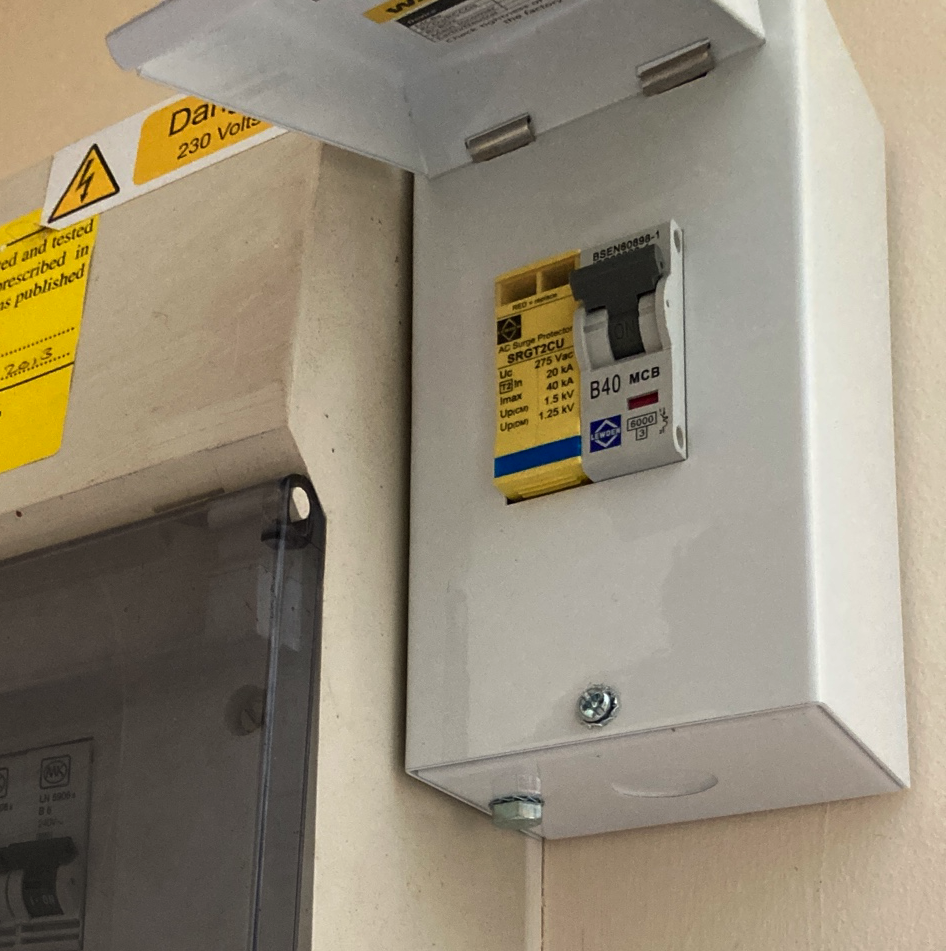
A surge protection device sits in your electrical installation and diverts the excess energy from a voltage spike away from your equipment, rather than letting it pass through to your appliances. Think of it as a relief valve — under normal conditions it does nothing, but the moment voltage spikes above a safe threshold, it opens a path for that excess energy to escape safely, protecting whatever's downstream.
There are three types, and most installations need more than one working together:
Type 1 is fitted at the property's incoming supply. It's designed to handle the big one — a direct or near-direct lightning strike — and its job is to stop that surge from reaching a level that could cause fire or serious injury. It won't, on its own, protect sensitive electronics from smaller day-to-day switching surges.
Type 2 sits at the consumer unit and protects the fixed wiring and equipment in the property from surges that get past the Type 1 stage, or from switching transients generated within the building.
Type 3 is fitted close to, or built into, sensitive equipment — protecting things like alarm panels, home networking kit, or AV equipment from the smaller, more frequent transients.
You'll also see "combined" SPDs that pack more than one type into a single unit (Type 1+2, for example), which can simplify installation.
On new consumer unit installations, we fit metal-clad consumer units with an integrated Type 2 SPD as standard — it's wired in parallel with the main supply, so it's protecting the whole installation from the point it comes in. Where a customer already has a consumer unit that's otherwise sound, we can often fit a separate Type 2 SPD alongside it rather than replacing the board.
For anyone with particularly sensitive equipment — home office kit, AV systems, EV chargers — we'd also talk through plug-in Type 3 protection for those specific circuits.
Every SPD we install has a visual indicator so you can see at a glance that it's still working, and our electrician will show you exactly what to look for and where it is before we leave site.
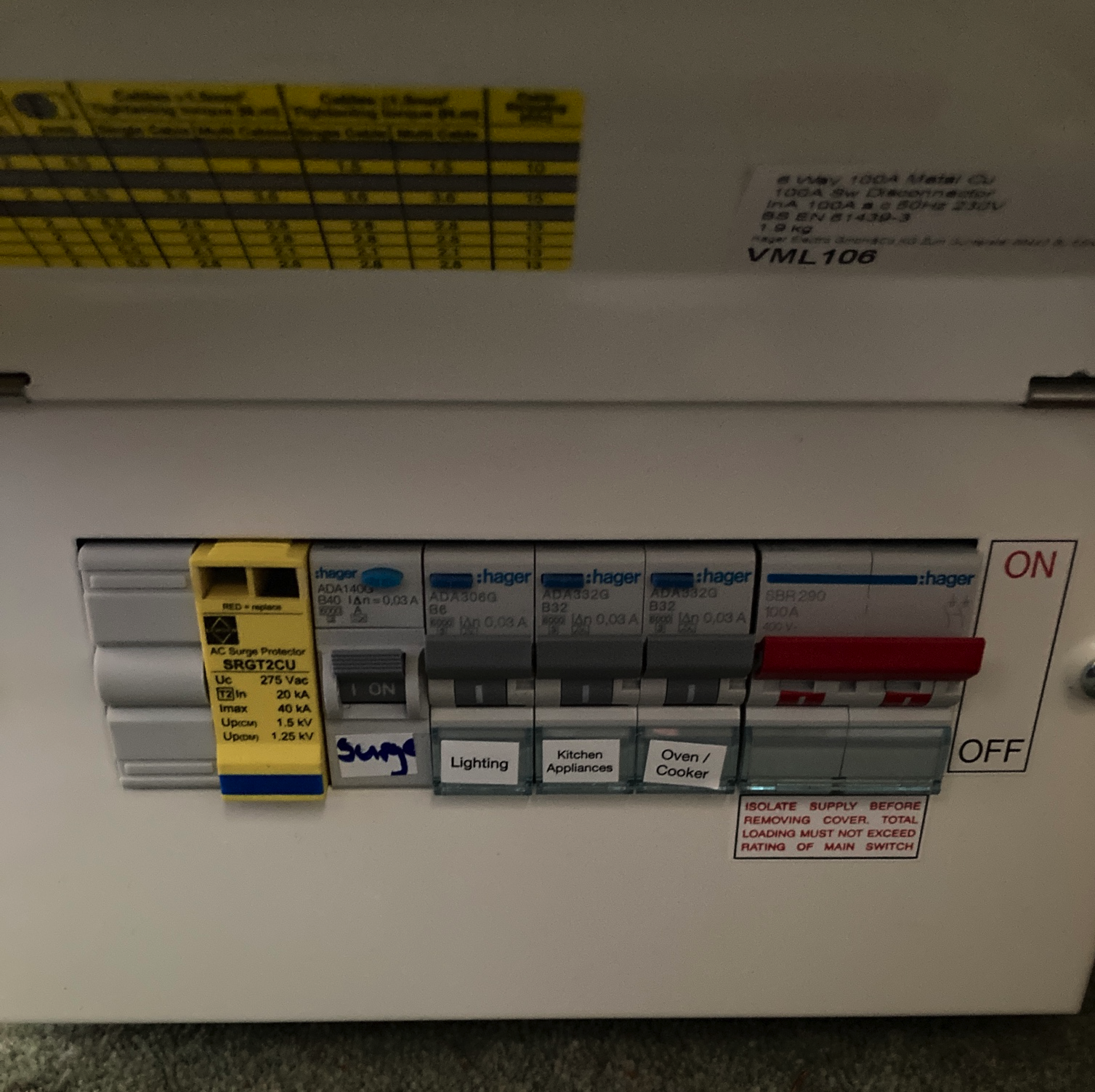
If you're having a consumer unit replaced or a rewire done, the answer is very likely yes — it'll usually be picked up by the risk assessment as part of that job anyway, so it makes sense to have it fitted at the same time rather than as a separate visit later.
If your consumer unit is otherwise fine and you're not having other work done, it's still worth asking about, particularly if you've got solar PV, an EV charger, or a lot of electronics in the property. Give us a call and we can talk through whether it's worth doing on its own.
If you are ever in doubt about the condition of your SPD, or if you have any questions about surge protection, please don't hesitate to contact a qualified electrician.
With SPDs in place, you can rest assured that your property and possessions are safe from the damaging effects of electrical surges.
If you're weighing up whether your consumer unit needs replacing altogether rather than just adding surge protection to it, our guide on how to know if you should change your board covers the warning signs. If it's the terminology that's confusing you, what's the difference between a fuse board and a consumer unit is a good place to start, and how much would it cost gives you a realistic idea of pricing before you get a quote.
If you're not sure which of these applies to you, get in touch and we'll talk it through — no obligation.
For more information on SPDs, please check out our blog post: SPDs - Your First Line of Defense Against Power Surges. If you need any assistance choosing the right SPD for your home or business, please don't hesitate to contact us.
Our team of qualified electricians would be more than happy to help you select the best surge protection solution for your needs.
Do I legally need surge protection fitted? Under the current wiring regulations, SPDs are required wherever a risk assessment shows a surge could have serious consequences — this covers most commercial and public premises, and increasingly domestic properties too, especially where a consumer unit is being replaced or a rewire is taking place.
Will an SPD stop all appliance damage from surges? No device can guarantee 100% protection against a direct lightning strike, but a correctly specified SPD (or combination of Type 1, 2 and 3) will substantially reduce the risk of damage from the vast majority of surges, including the switching transients that cause most day-to-day wear on electronics.
Can I fit surge protection without replacing my whole consumer unit? Yes. If your existing consumer unit is in good condition, a separate Type 2 SPD can usually be fitted alongside it without a full replacement.
How do I know if my SPD is still working? Most SPDs, including all the ones we fit, have a visual indicator showing they're functioning correctly. We'll show you exactly what to look for at installation. Some older or unmonitored units need periodic testing with a surge tester instead.
To book a very helpfull & knowledgeable Bright Spark Electrician to carry out a Survey, and provide a Free of Charge Quotation, fill out our simple form to visit your home. click [Click this Link]
For further Information, please do not hesitate to contact us.
Telephone: 01892 531728
I was really impressed with the work done for me by Bright Sparks. It is lovely that they are local to me in Hildenborough and grateful that they could fit me in at short notice. The repairs were done quickly and easily by Charlie and the whole thing coordinated by Karen who kept me informed every step of the way. Well done Bright Sparks!
‘Excellent service, quick and very efficient. Tidy work. No problem recommending Karen and her team. Will definitely use these guys again!’
I just wanted to say how amazing your customer service is. You are the first (and only?) trade company that communicates and is efficient from my experience. I really appreciate texts, and emails giving me updates. It means I don’t have the frustration of having to stay in for the electrician all day and waste my time. You run an excellent service. Your electrician was great and very quick. We will definitely be using you again.
I have used Bright Sparks for two jobs and have been delighted with the quality of the work carried out. Karen is very knowledgeable in her subject and her staff are very well trained , courteous and hard working. I would highly recommend the company without hesitation.
Very pleased with the Bright Spark team who installed a new Zappi EV charger and replaced our consumer unit. Many thanks for another job well done. Neat & clean. 10/10


