

Where Bright Ideas
Come to Life!
Come to Life!
A fuse board is the old-style unit that controls the electrics in your home, using rewireable fuses or fuse cartridges. A consumer unit is the modern replacement, using RCBOs and RCDs that trip instantly and reset with a switch — no fuse wire, no wholesaler trip, no guesswork. If your property still has a fuse board, it's likely decades old and won't meet current wiring regulations (BS 7671).
I get asked this a lot on site, usually by someone who's just opened their cupboard under the stairs and found a black box with wire wound round little screws. Here's what's actually going on.
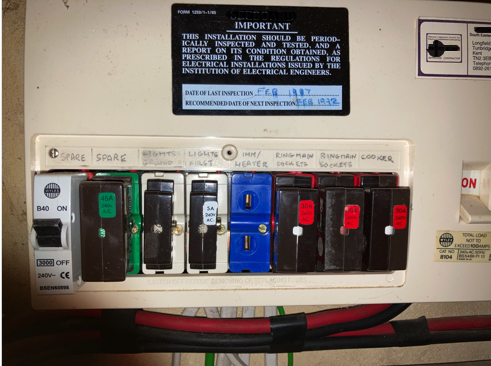
The original fuse boards, often labelled BS 3036, protected circuits with an actual fuse — either a piece of fuse wire screwed into a cartridge, or a specific-rated fuse carrier you'd have to source from an electrical wholesaler. When a circuit overloaded or faulted, the wire burnt out. Someone then had to rewire it by hand, or track down a spare carrier fuse, before power came back on.
That's manageable for the odd one-off fault. It gets tedious — and risky — when a circuit keeps tripping and gets re-fused each time without anyone asking why. Repeated fuse blowing is usually a symptom of a deeper fault, not something to just patch and ignore.
Today's boards use miniature circuit breakers (MCBs) and, on anything up to current standard, RCBOs — a Residual Current Breaker with Overload, which combines overload protection with fault protection on a single circuit. Older-style split-load boards used RCDs (Residual Current Devices) covering several circuits at once.
The practical difference: no fuse wire, no wholesaler trip, no waiting. A tripped circuit resets with a flick of a switch — and if it trips again immediately, that's your signal something needs investigating rather than repeatedly resetting it.
Larger installations, or properties with multiple boards, may call these distribution boards rather than consumer units, often labelled DB1, DB2 and so on so the circuits are easy to identify.
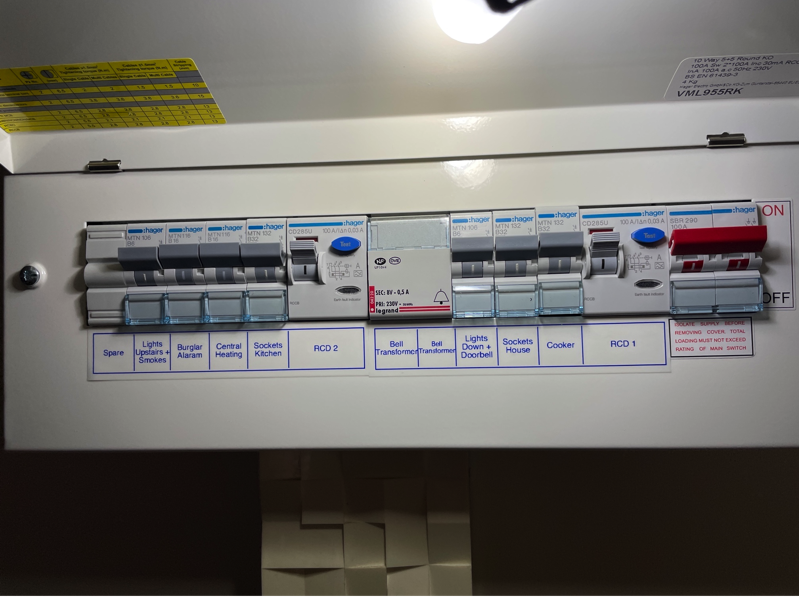
Old fuse boards don't offer the same level of protection as a modern RCBO/RCD consumer unit, particularly against electric shock and fire risk from earth faults. BS 7671 Amendment 3 also requires consumer unit enclosures to be made of non-combustible material — metal, not the plastic used in older units — specifically because of fire risk from arcing faults.
If you're selling a property, letting it out, or making an insurance claim after an electrical incident, an outdated fuse board can become a real problem. Mortgage valuers and letting agents increasingly flag it, and some insurers ask directly about board type after a claim.
If you've still got a fuse board with rewireable fuses or fuse carriers, yes — it should be upgraded to a modern consumer unit. This isn't a scare tactic; it's the same conclusion an EICR (Electrical Installation Condition Report) will reach if one's carried out on your property, and it's what most electricians will recommend on sight.
A consumer unit upgrade must be carried out by a qualified, registered electrician and completed under Part P Building Regulations, with a certificate confirming the work meets those requirements.
If you're not sure what's in your cupboard, read our guide on how to know if you should change your board, or find out what a board change actually costs. We also cover how long a board change takes if you're planning around it.
We also carry out PAT testing and full consumer unit replacements — contact us if you'd like a survey.
No. A fuse box (or fuse board) uses rewireable fuses and is the older technology. A consumer unit is the modern replacement, using MCBs and RCBOs/RCDs, and is what current regulations require.
Cartridge and carrier fuses are increasingly hard to source and are being phased out by wholesalers. This alone is a good reason to upgrade rather than keep repairing an old board.
In most cases, yes. An outdated fuse board is one of the most common reasons a property fails an EICR, and it's usually flagged as needing attention.
If you have to rewire a fuse or fetch a replacement cartridge from a wholesaler when something trips, you have an old-style fuse board. If a switch flicks and resets instantly, you have a modern consumer unit.
If you have any questions or require further assistance, please do not hesitate to contact Bright Spark Electrical Services.
To book a your survey or receive a free bespoke quotation from a knowledgeable Bright Spark Electrician, simply fill out our form here.
For further inquiries, reach out to us via telephone at 01892 531728 or email at karen@brightsparkelectrician.co.uk.
I have used Bright Sparks for two jobs and have been delighted with the quality of the work carried out. Karen is very knowledgeable in her subject and her staff are very well trained , courteous and hard working. I would highly recommend the company without hesitation.
You just saved us the biggest headache ever; after months of electrical problems ( now resolved), we had a ‘no power situation’. After checking circuit boards, switches etc we were at a complete loss. Read your piece above (after Googling ‘circuit board switches up, but no power‘) about RCD switch and resetting (didn’t know what an RCD was), and after 8 hours sleep dreaming of circuit boards and 2 minutes of contemplation, and re-reading your advice,I totally nailed it. Brilliant tutorial, many thanks. Susanne (I am neither young nor savvy with anything technical)
Prompt courteous service, with very competitive rates. I have no reservations to recommend this Company.
We used Bright Sparks to resolve some electrical problems. They succeeded where previous electricians failed! We found them to be reliable, courteous and fairly priced.
Very pleased with the excellent job from the Bright Spark team. Really informative and helpful advice from Karen and Richard the electrician was friendly, professional and a pleasure to deal with. Will use again. Thank you very much for a job well done.Update: just used Bright Spark again (Aug 25) and Joe did an excellent job and Karen's communication was excellent. Thank you very much.


