

Where Bright Ideas
Come to Life!
Come to Life!
I've been doing this job for over 25 years, and I still don't get called out to a direct lightning strike very often. Near misses and induced surges, yes — a few times a year. An actual direct hit, where lightning finds the house itself and rides straight through the wiring? That's rare. This week I attended one in West Kent, and the damage was significant enough that I wanted to write it up properly — partly because it's a genuinely useful case study on how lightning behaves once it's inside a building, and partly because most of what's written online about "lightning and your electrics" is generic filler that doesn't match what I actually found on site.
This article walks through exactly what happened at this property, corner by corner, room by room, and explains the electrical theory behind each bit of damage — why the satellite cable was the point of entry, why the consumer unit failed the way it did, why a service fuse can physically explode, and why this customer now needs a full EICR before we can safely re-energise the property. If you've had a lightning strike near your home, or you're trying to work out whether your own consumer unit would survive one, this should give you a realistic picture rather than a textbook one.

A direct strike doesn't politely follow your wiring diagram. Lightning is looking for the fastest route to earth, and it will take whatever conductive path gets it there — cable, pipework, brickwork, reinforcing bar, guttering, aerials, satellite dishes, it doesn't discriminate. In this case, the strike came down on one corner of the property and found the satellite cable running up the outside wall. That cable, and its earthing/screening, gave the current a metal path straight into the building.
To put the scale of this in perspective: a typical UK socket delivers 230 volts and is protected by a circuit somewhere around 13 amps. A negative lightning strike — which accounts for roughly 90-95% of all cloud-to-ground lightning — carries somewhere in the region of 300 million volts and around 30,000 amps. The rarer positive strikes, which originate higher in the storm cloud, can carry anywhere from 120,000 to over 400,000 amps and up to a billion volts. Even at the lower end of that range, you're looking at a current somewhere around two thousand times what a domestic socket circuit is designed to carry, arriving in a fraction of a second. That's the scale of event every fuse, breaker and cable in a house is up against, and it's why nothing in a standard domestic installation is realistically built to "handle" a direct strike — the best any of it can do is fail in a way that protects the rest of the building and the people in it.
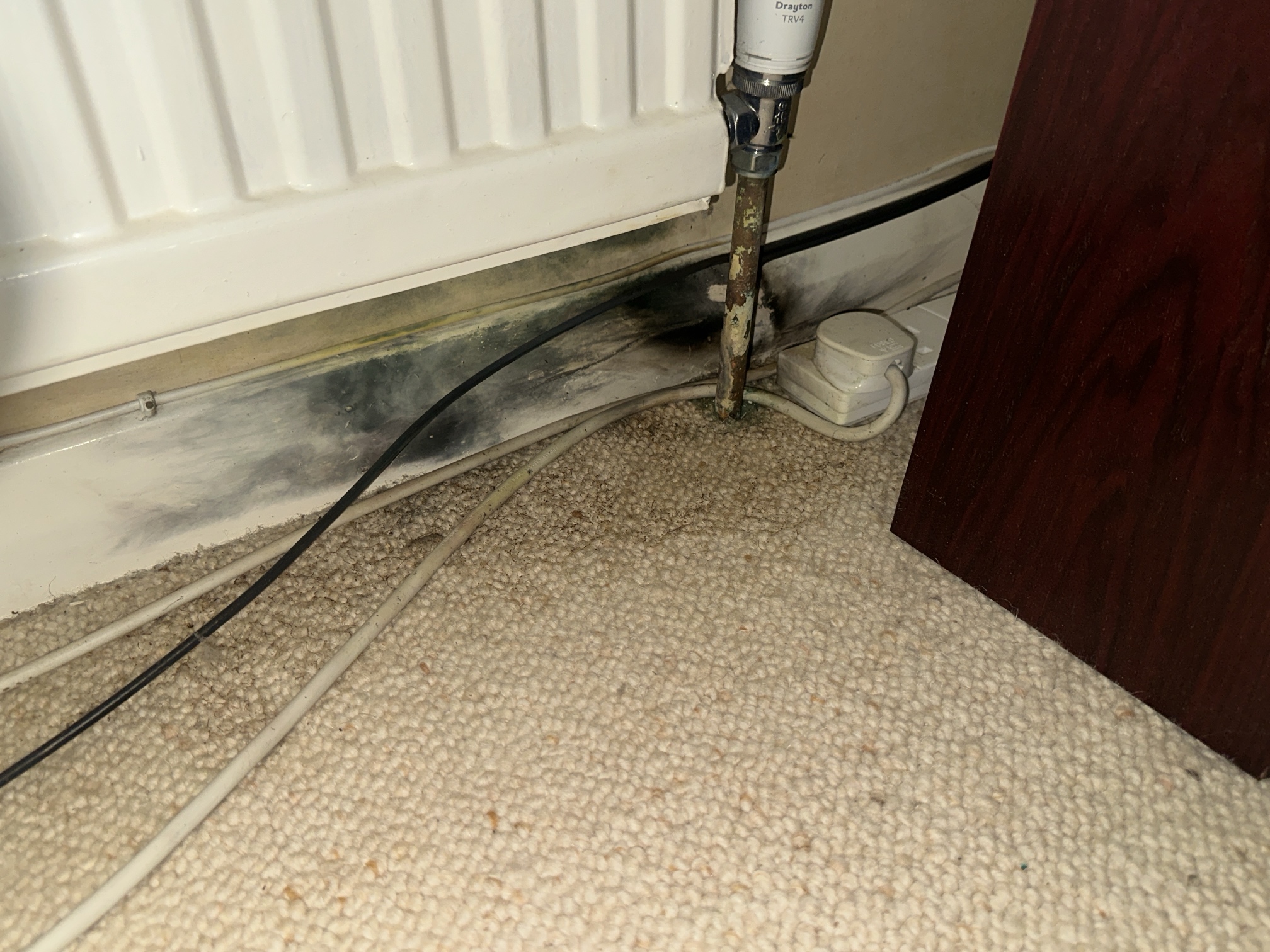
Once inside, the current didn't stay on one nice tidy circuit. It jumped from the satellite cable to the central heating pipework, because at some point the two ran close enough together for the current to arc across — pipework is usually copper, and copper is a superb conductor. From there it used the heating pipes as a second route to earth, which is exactly why the pipework ruptured at the stop cock in the garage, nowhere near where the lightning actually struck. That's the single most important thing to understand about lightning damage: the point of entry and the point of failure are often in completely different parts of the house, because the current is hunting for the quickest way down to earth, not following a straight line.
At the same time, a strike this close generates a massive, near-instantaneous electromagnetic pulse. Every long run of cable in the house — mains cables, telephone cables, TV aerial leads, speaker cable — acts a bit like an aerial itself, picking up an induced voltage spike even where there's no direct physical contact with the strike path. That's why you can get damage to sockets, TVs and a stereo system in bedrooms and living rooms that are nowhere near the corner of the house that got hit. The current found one physical route to earth through the fabric of the building; the pulse affected wiring throughout it.
Direct strikes on domestic properties are genuinely uncommon compared with the storms themselves. The UK sees somewhere in the region of 200,000 to 300,000 lightning strikes a year on average, but the overwhelming majority hit open ground, trees, or taller structures that offer an easier path to earth than a two-storey house. A chimney stack, a nearby tall tree, overhead cabling, or even the satellite dish and aerial fittings on a roof can all become the preferred route for a strike that might otherwise have missed the building entirely.

That's part of why this case is worth documenting properly rather than treating as a one-off oddity. Most of what people read about "lightning and electrics" online is written from a general safety or insurance angle, not from someone who's actually stood in the property afterwards and traced the current path room by room. The pattern here — entry via a roof-level cable, arcing across to metal pipework, exit through the weakest joint in that pipework, and induced damage throughout the rest of the building — is a genuinely instructive one, because it's the same basic physics that plays out in every direct or near-direct strike, even though the specific fittings involved will differ from house to house.
This part of the story is worth its own section, because it's the bit most homeowners find hardest to believe until it happens to them. Neighbouring properties up to a quarter of a mile from the strike also lost equipment — internet routers, satellite boxes for their televisions, and pond pumps running ornamental fish ponds. The fish, for what it's worth, survived; the pumps didn't.
None of those properties took a direct hit. What they shared with the struck house was a connection to the same local low-voltage distribution network, and in some cases the same overhead phone and broadband infrastructure. When a strike of this size discharges into the ground near a property, or into the electrical infrastructure serving a street, it doesn't stay neatly contained to one address. The surge can travel back along the supply network, along shared earth paths, and along telecoms cabling that runs pole to pole or underground alongside the electricity network, arriving at neighbouring properties as a smaller, but still very real, voltage spike.
Router and satellite box damage fits this pattern exactly. Both types of equipment sit permanently connected to two separate networks at once — mains power on one side, and either a phone line, broadband line, or a satellite/aerial feed on the other. That makes them a favourite casualty of induced surges travelling in from outside the property, because a spike doesn't need a direct strike on your roof to reach the delicate low-voltage electronics inside; it just needs a way in through either connection, and these devices offer two.
Pond pumps are a slightly different case, but no less understandable. Many are wired on an outdoor circuit, often run some distance from the house to reach the pond, and outdoor cabling of this kind is more exposed to induced voltage from a nearby strike than cabling buried safely inside a building. A pump motor's windings are also a fairly simple, and fairly vulnerable, target for a voltage spike compared with, say, a heavily protected mains-only appliance. The fact the fish survived isn't surprising — water is an excellent conductor and tends to dissipate stray current quickly and safely, which is exactly why pond and fountain electrics need proper RCD protection and correctly rated outdoor cabling in the first place, strike or no strike.
The wider point for anyone reading this who wasn't at the struck property themselves: if there's been a significant lightning strike anywhere near your street, it's worth checking your own router, satellite box, and any outdoor electrics — pond pumps, garden lighting, outbuilding supplies — even if your own house shows no signs of a strike at all. Damage like this often doesn't show up as anything dramatic. Equipment just quietly stops working, and it's easy to assume it's coincidence rather than connect it back to the storm.
I want to go through this room by room, because the pattern of the damage tells its own story about how the strike travelled through the building.
The satellite cable on the outside wall was the initial casualty. It "frazzled," in the customer's words, and that's about the most accurate description you can give — the copper conductor and shielding will have vaporised or partially melted under the current, generating enough localised heat to ignite the cable jacket. This is the point where the strike found its way into the building's services.
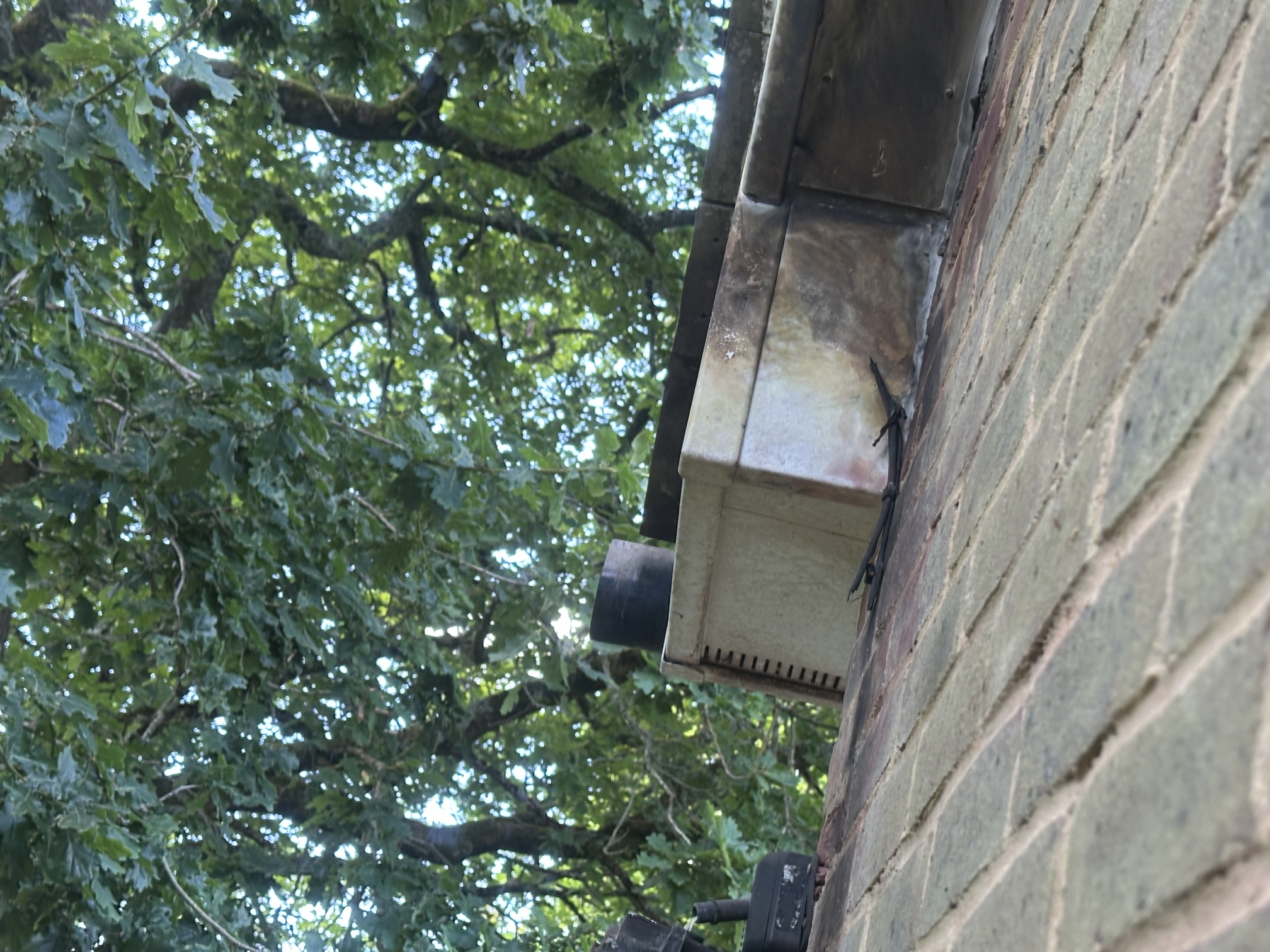
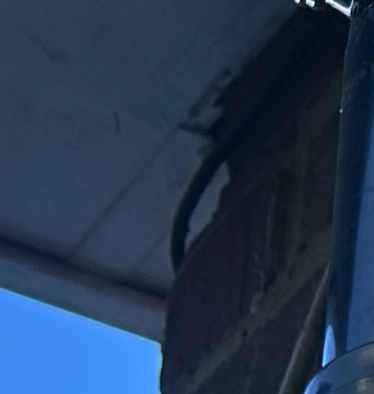
A chunk of brick was knocked clean off the corner of the house and landed on the conservatory roof. This is a common feature of direct strikes — the moisture inside brick and mortar flashes to steam almost instantly when a huge current passes through or near it, and the resulting pressure can physically blow masonry apart. It's not electrical damage in the sense we usually deal with, but it's diagnostic: it tells you where the strike actually made contact with the building fabric, which helps make sense of everything that follows.
As covered above, the current arced from the satellite cable to the central heating pipework and used it as a route to earth. The pipework ruptured at the stop cock in the garage — likely the weakest joint in that run, or the point where resistance was highest and heat build-up was greatest — and the contents of the system emptied out across the garage floor. Because the pipework is connected to the boiler, the boiler now needs to be fully checked over before anyone tries to fire it back up. You don't know what a surge of that size did to the boiler's own PCB, pump, or safety controls until it's been inspected, and running it blind after this kind of event is not something I'd recommend to any customer.
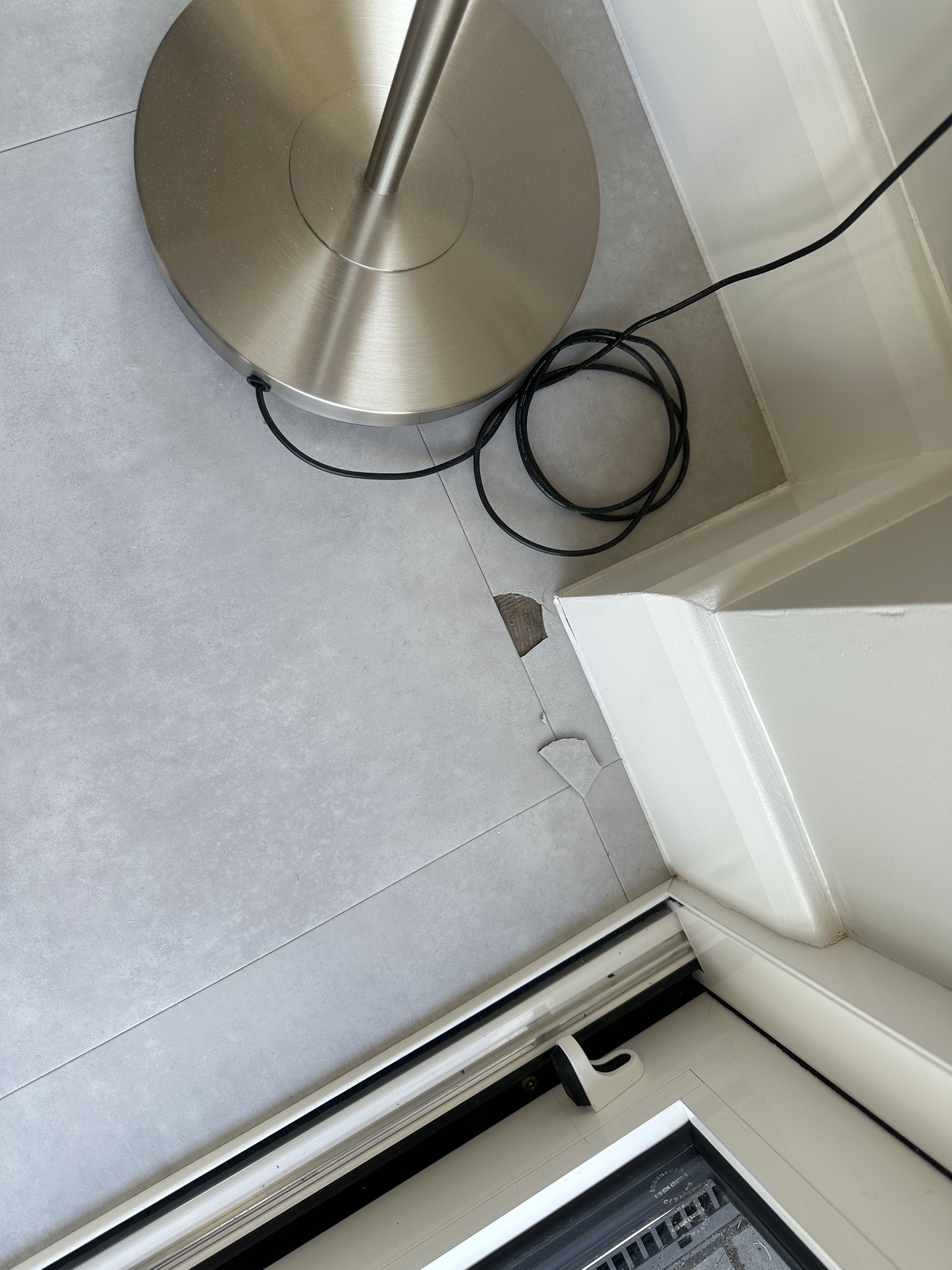
At the rear of the property, cables ruptured with enough force to damage the vinyl flooring above them. This is consistent with a cable carrying far more current than it was ever designed for — the conductor heats almost instantaneously, the insulation fails, and depending on how the cable is routed (in this case, apparently under or near the flooring) that heat and pressure transfers upward into whatever's sitting on top of it.
In the bedroom, there's fine black dust under the television and on the ventilation grille above it. That's a classic sign of an internal component failure caused by a voltage spike — capacitors and other components on the mains input side of a TV's power supply can fail catastrophically when hit with a surge well beyond their rating, and when they do, they can produce exactly this kind of fine carbon residue as the component material burns. The fact it's visible both under the unit and on the grille above tells you there was enough energy released to project debris upward through the casing vents.
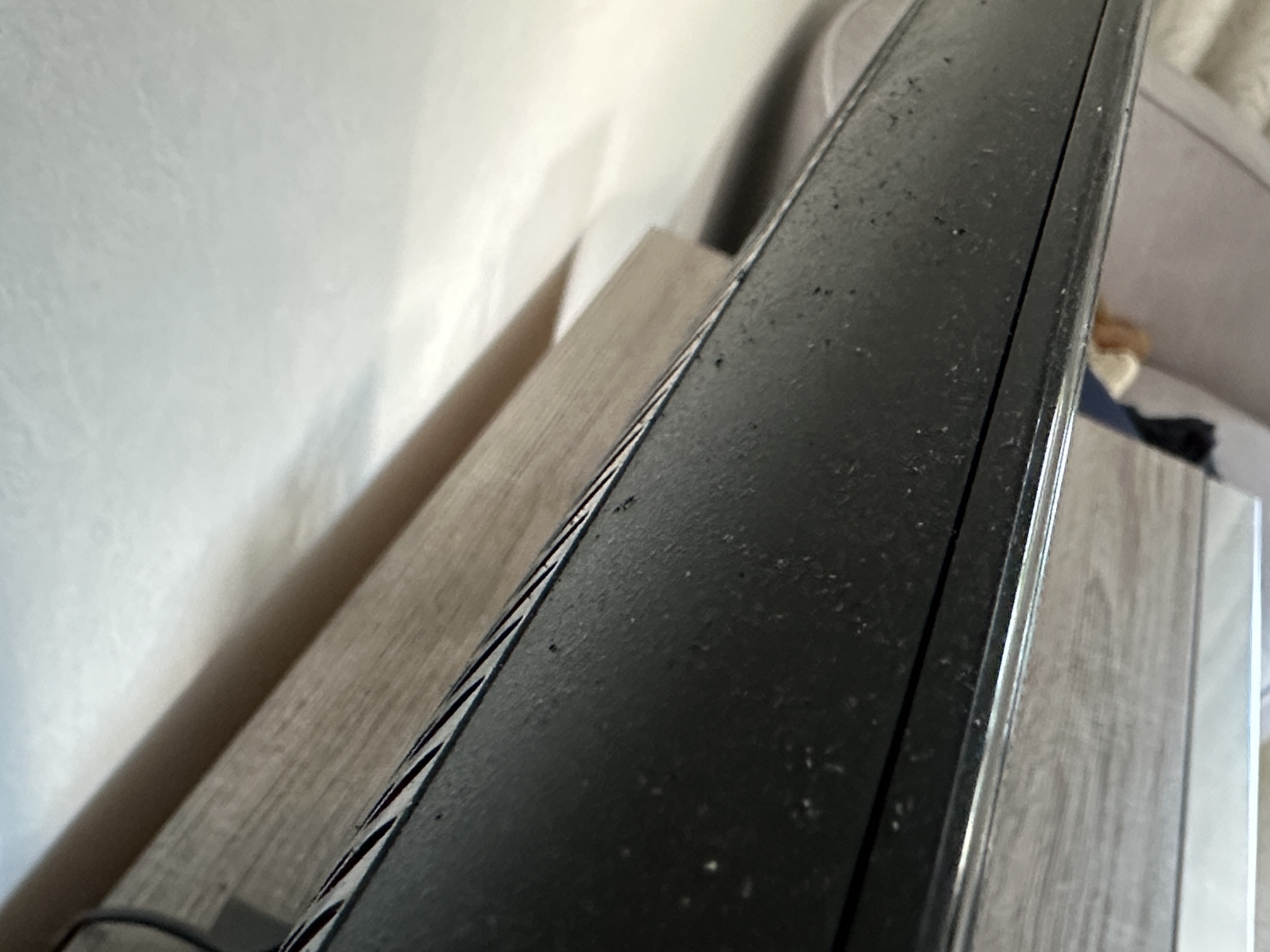
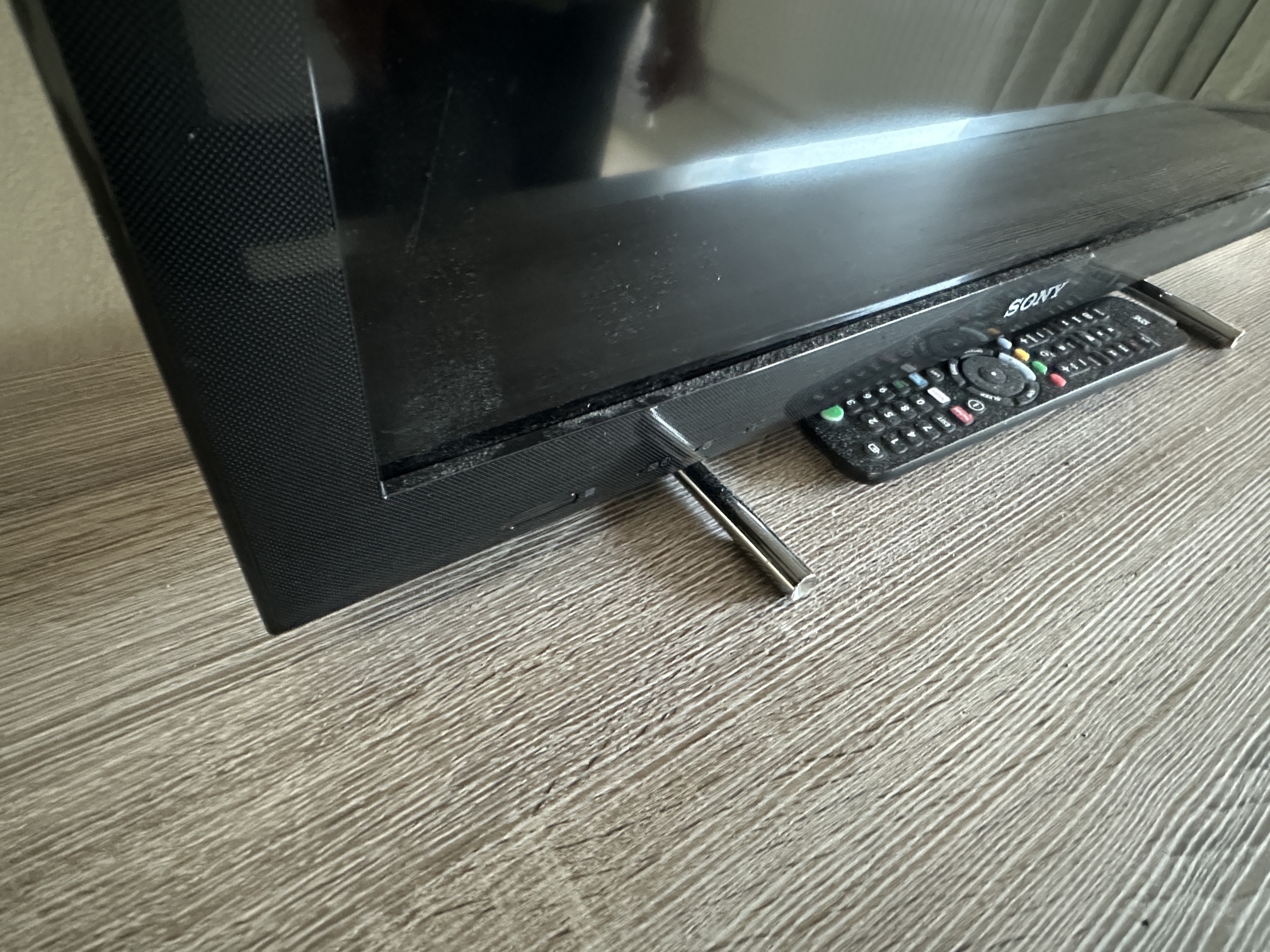
The tower fan in the same bedroom is presumed fried, though it hasn't been tested yet because there's no power to the property. Same story with the customer's stereo system — it's untested, but given its proximity to the frazzled satellite cable, I'd expect it to be condemned once assessed. Sensitive electronics with switch-mode power supplies (which is most modern kit — TVs, amplifiers, fans with electronic speed control) are far more vulnerable to voltage spikes than older, simpler mains-only appliances, because their internal circuitry runs at much lower voltages and has far less tolerance for a spike.
Telephone sockets were blown clean out of the wall, singed and melted. Telephone lines are long, thin, and typically unshielded compared to mains cable, which makes them particularly good at picking up induced voltage from a nearby strike. Once that induced voltage exceeds what the socket and its internal components can handle, you get exactly this: physical ejection from the wall, scorching, and melted plastic.


Curtains close to the affected sockets were singed by the heat and any sparking from the failure. Elsewhere, cables burst out of the walls with enough force to blast fragments of plaster across the room — some of it embedded in the wall opposite. That's not a small event. For plaster fragments to embed in an opposite wall, you're looking at an explosive failure at the cable termination point, most likely a socket or a joint box, where trapped gases from the arc and instantaneous heating had nowhere to go but out.
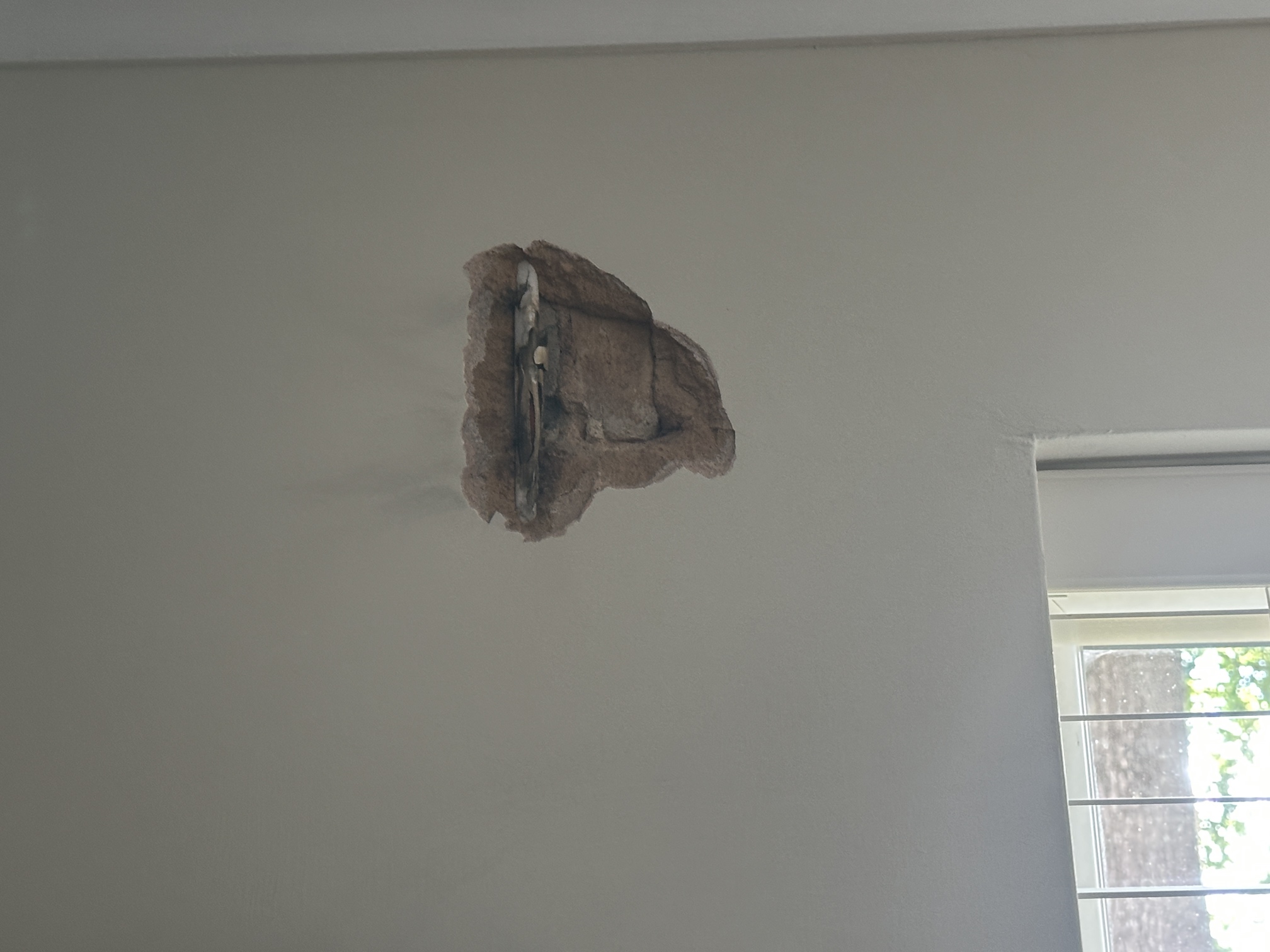

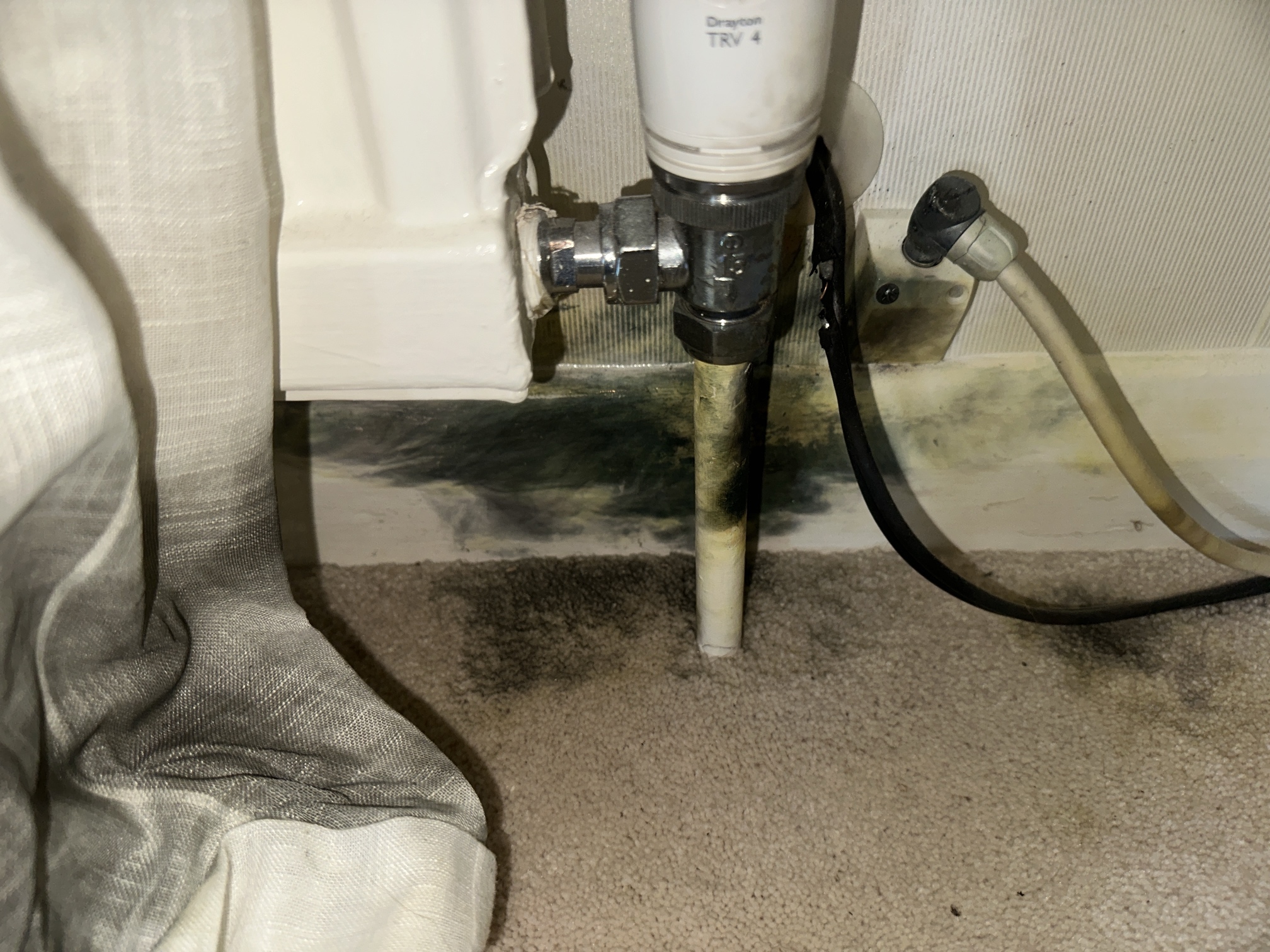
The service head fuse — the fuse that sits before your meter, owned and fitted by the electricity distributor, not something we as electricians are allowed to touch — exploded. Fragments were found scattered across the cars parked in the garage. The service fuse is designed to be a sacrificial device: its entire job is to fail and break the circuit if the current through it exceeds its rating, protecting everything downstream. What it isn't designed to survive is a lightning-magnitude current, which is many, many times higher than anything it's rated for. When a fuse element of that size has to interrupt a current that far beyond its design limit, the energy has to go somewhere, and in this case that meant a physical, explosive failure of the fuse carrier itself.
The meter was damaged in the same event, again throwing fragments into the garage. Like the service fuse, the meter simply isn't built to have anything like a lightning strike's current pass through it. Once the service fuse and the meter had both failed, the district network operator's engineer needed to attend to fit a new service fuse and meter along with a separate isolator — which has now been done, giving us a safe point to work from.

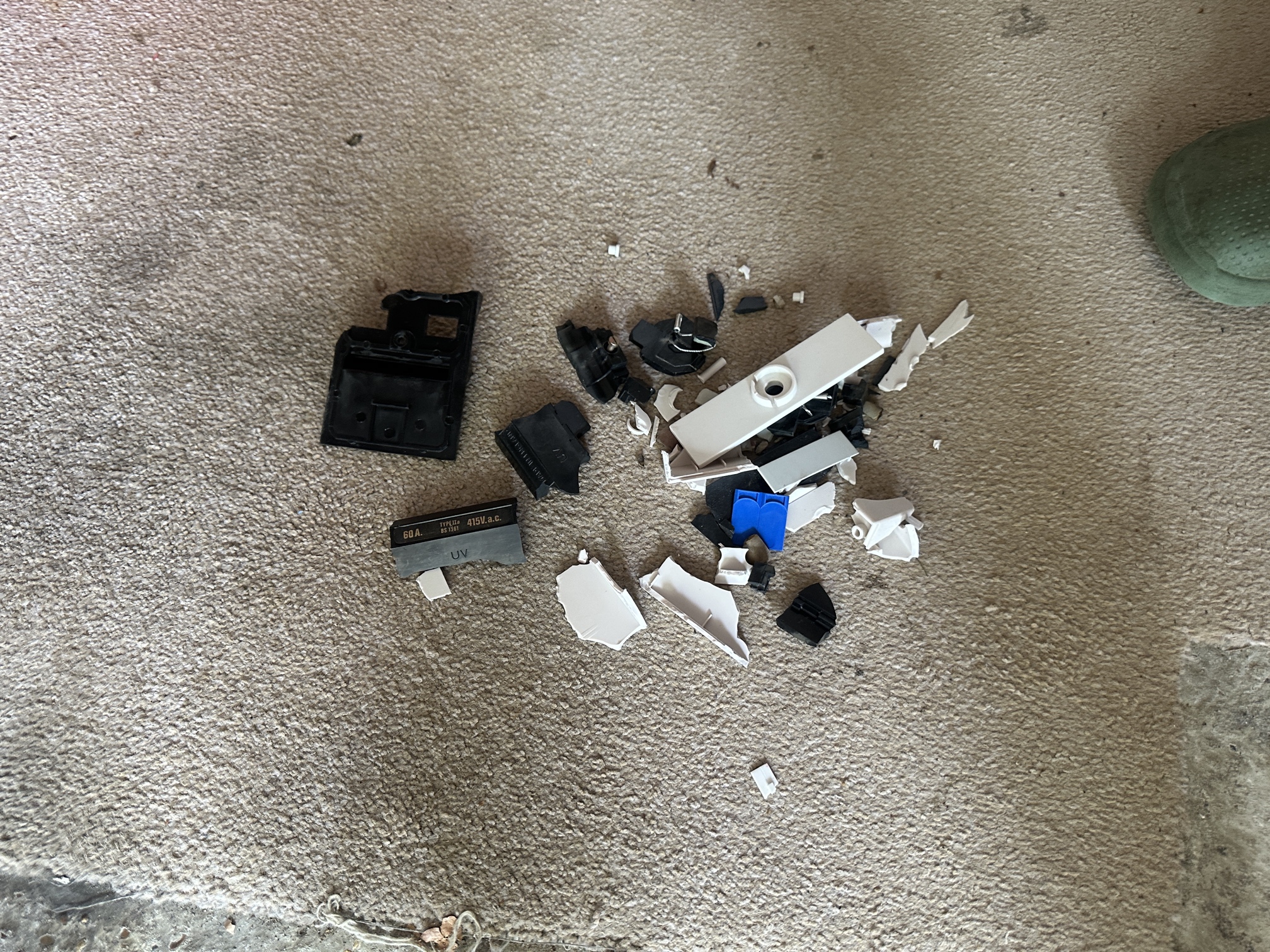
Inside, the main consumer unit fared just as badly. Circuit breakers and RCDs were physically blown out of their housings and rendered ineffective. This is worth explaining properly, because it surprises a lot of people — most homeowners assume their RCDs and circuit breakers are there to protect them from exactly this kind of event, and in a sense they are, but only within their design limits.

An RCD is designed to detect a small imbalance between live and neutral current — as little as 30mA in a domestic device — and trip within milliseconds to prevent electric shock. A circuit breaker (MCB) is designed to detect overload or short-circuit current, typically anywhere from 6A up to 32A or so on a domestic circuit, and interrupt it before the cable overheats.
Both of these devices are engineered around interrupting fault currents that are large by everyday standards but genuinely tiny compared to what a lightning strike delivers. Even an average negative strike, at around 30,000 amps, is roughly a thousand times more current than a typical MCB is rated to break, and a direct or near-direct strike can involve currents at a magnitude that dwarfs anything a domestic protective device is rated to break safely. When a breaker or RCD is asked to interrupt a current vastly beyond its rated breaking capacity, it doesn't necessarily trip cleanly and safely the way it would for an everyday fault. The internal contacts can weld, vaporise, or be blown apart by the arc energy, which is consistent with what I found here — devices physically ejected from their housings rather than simply tripped to the "off" position.
This is also exactly why we can't just flick everything back on and call it a day, even now that a new service head and meter are fitted. A consumer unit full of RCDs and breakers that have been through an event like this cannot be trusted, even if some of them look intact. Anything that's been subjected to a fault current that far outside its design parameters needs to be treated as suspect until proven otherwise, which is one of several reasons the next step has to be a full inspection rather than a straight swap of the damaged bits.
The power's been off at this property for a few days now, and it needs to stay off until we've done a full Electrical Installation Condition Report (EICR) across the property. Here's why that's not optional, and not just me being cautious for the sake of it.
We know the current found at least two paths through this property — the satellite cable/pipework route, and whatever induced surge affected the bedroom sockets, TV, fan, stereo, and telephone points. What we don't know yet is what that surge did to every other circuit and cable run in the house that isn't showing obvious visible damage. Cable insulation can be weakened by heat or an arc without failing outright at the time — it can look fine and still be compromised, only to fail weeks or months later under normal load. The only way to find that out is to test every circuit properly: insulation resistance testing, continuity testing, checking every protective device, and physically inspecting accessible cabling and connections throughout the property.
This is also why we always insist on doing the EICR before touching the consumer unit itself. If we replaced the consumer unit first and then found problems in the fixed wiring during testing, we'd be pulling the new board apart again to trace and fix issues we already knew were there. Testing first tells us the true scope of the damage across the whole installation, so we can quote for everything that actually needs doing in one go, rather than in stages that cost the customer more in labour and disruption.
Until that EICR is complete, the boiler is being held off too, since it was connected to the pipework that took part of the current path, and it needs its own check before it's fired back up.
I want to give you an honest answer here rather than a sales pitch, because a direct lightning strike and a nearby indirect surge are genuinely different events.
A surge protection device (SPD) fitted at the consumer unit is designed to clamp down transient overvoltages — the kind caused by switching events on the grid, or by a lightning strike some distance away that induces a voltage spike on the incoming supply. It works by diverting that excess voltage safely to earth before it reaches your appliances and circuits. For the vast majority of surge events, that's exactly the job it does, and it does it well.
A direct strike, or a near-direct one like this where the current physically enters the building fabric through a cable, is a different order of magnitude of energy. No domestic SPD is designed to absorb or divert the full current of an actual lightning bolt — nothing at consumer-unit scale is. What an SPD would likely have done in a case like this is protect some of the equipment connected downstream of the consumer unit from the induced voltage spike travelling through the property's mains wiring — quite possibly reducing the damage to the TV, and potentially helping the stereo, depending on exactly how the current and the induced pulse travelled through the building. It would not have stopped the physical current path that went in via the satellite cable, through the heating pipework, and out through the stop cock — that's a structural and physical event, not something a consumer-unit-mounted SPD is positioned to intervene in.
So the honest answer is: SPDs reduce the damage from surges, including many lightning-related ones, but they're not a guarantee against a direct or near-direct strike, and anyone telling you otherwise is overselling it. What they are is a genuinely worthwhile, and since 2022, effectively expected piece of protection for the surges that happen far more often than a direct hit — switching surges, and induced spikes from strikes that hit the grid or a property some distance away. We've written about this in detail, including what the regulations actually require, in two other Knowledge Centre articles: Surge Protection Devices: Do You Need One? and Do You Need a Surge Protector? What UK Homeowners Need to Know. If your consumer unit was fitted before 2018, there's a good chance it has no SPD at all, and it's worth reading those before your next fuse board conversation with us.
I'd say this regardless of whether it helped my own business, but it matters enough that I want to spell it out. After an event like this, there's a temptation to just get "someone in" quickly to sort the power out and move on, especially with a family living without electricity for days. I'd push back on that.
An EICR after storm or lightning damage isn't a box-ticking exercise — it's a genuine diagnostic process that determines whether the fixed wiring throughout the property is safe to re-energise, and it needs to be carried out and signed off by someone properly qualified to interpret what the test results actually mean. On jobs like this one, our NICEIC Qualified Supervisor, Phillip, reviews and signs off the completed inspection, which matters both for your own safety and for your insurer, who will want to see a report from a competent, registered source before settling a claim of this size.
There's also a practical reason to use someone who deals with this kind of fault regularly rather than routine domestic work. Storm damage doesn't always announce itself with an obvious burn mark or a smell of smoke. Tracing a current path that's gone from a satellite cable, into heating pipework, and out through a stop cock two rooms away takes a working understanding of how these systems interact, not just a socket tester and a torch. Get it wrong, or miss a compromised section of cable because it wasn't tested properly, and you're looking at a fault — or worse, a fire risk — turning up months later once everything's plastered over and forgotten about.
If you suspect lightning has struck your property directly, or landed close enough to cause damage, don't try to reset anything yourself. Don't flick breakers back on to "see if it works," and don't plug anything back in to test it, even if the power's on. If you can smell burning, see scorch marks, or notice a strange smell around sockets or the consumer unit, isolate the property at the main switch if it's safe to do so, and get it looked at before using it again.
Check for gas or water leaks if you have any pipework that runs anywhere near affected cabling — in this case, that connection between the satellite cable and the heating pipes is exactly the kind of thing that isn't obvious until someone traces it properly. If your boiler, cooker, or any gas appliance was on a circuit anywhere near the strike, treat it as suspect until it's been checked by the relevant trade.
Photograph everything before anything is moved or cleared up, for your insurer's benefit as much as for the electrician who'll be assessing it. And get an NICEIC-registered electrician out to assess the installation before you rely on any part of it again, even circuits that seem to be working normally. "Seems fine" and "is fine" are not the same thing after an event like this.
For this property, the sequence has been: isolate everything, get the distribution network operator out to fit a new service head fuse, meter, and a separate isolator (which has now happened), and then carry out a full EICR across the whole installation before we make any decisions about what gets replaced and in what order.
Once the EICR is complete, we'll have a proper picture of exactly which circuits, cables, and accessories need replacing, whether the consumer unit needs a full replacement (which, on the evidence so far, it almost certainly will), and what condition the rest of the fixed wiring is genuinely in. Only once we've got that full picture do we start the actual repair and reinstatement work — because doing it in the right order means the customer gets one accurate quote covering everything, rather than a string of unexpected extras as we find more damage during the rebuild.
Every property's different, and until the EICR is done on this one I couldn't give you an honest number for it specifically. But storm and lightning damage of this scale — a new consumer unit, replacement of damaged final circuits, sockets, and telephone points, plus making good the plaster and flooring — is a significant job, easily running into several thousand pounds once you add it all up, and that's before the boiler check and any structural brickwork repair.
The good news is that this is precisely the kind of event most buildings and contents insurance policies are designed to cover, since it's clearly storm/lightning damage rather than wear and tear or poor maintenance. What insurers will want is exactly what we're providing here: a clear EICR report setting out the scope of the damage, dated photographic evidence, and an itemised quote for the remedial electrical work. If you've had similar damage, get your insurer on notice early, keep photos of everything before it's cleared up, and get your EICR booked in as soon as it's safe to do so — the report is often the single document that determines how smoothly a claim goes through.
Can lightning really destroy a consumer unit and everything downstream of it? Yes. A direct or near-direct strike can carry tens of thousands of amps, which is far beyond what any domestic RCD, circuit breaker, or fuse is designed to interrupt safely. Rather than tripping cleanly, these devices can be destroyed by the fault current itself, which is exactly what happened in this case.
Why did appliances in rooms nowhere near the strike get damaged? Lightning generates an intense electromagnetic pulse alongside its physical current path. Long cable runs throughout the property — mains, telephone, aerial — can pick up an induced voltage spike from that pulse even without direct contact with the strike, which is why damage often turns up in rooms well away from the point of entry.
Is it safe to use any part of the electrics while waiting for an EICR? No. Even circuits that appear to be working can have weakened insulation or damaged components that aren't visible without proper testing. The only safe approach after an event like this is to keep the installation isolated until a full EICR has confirmed what's safe and what needs replacing.
Would a surge protection device have stopped this damage? Partially, at best. An SPD at the consumer unit is designed to clamp voltage spikes travelling in on the incoming supply, and would likely have reduced damage to some downstream electronics. It isn't designed to stop the physical current of a direct strike finding its own path through cables and pipework, which is a different kind of event entirely.
Who is responsible for the service head fuse and meter — is that something Bright Spark can replace? No. The service head fuse and the meter belong to the district network operator, not to you or to your electrician. If they're damaged, the DNO has to attend to replace them before any further electrical work can safely proceed, which is what happened at this property.
Will my home insurance cover lightning damage to my electrics? In most cases, yes — storm and lightning damage is typically covered under standard buildings and contents policies. Insurers will generally want a proper EICR report, photographic evidence, and an itemised quote to support the claim, so getting these done promptly and correctly matters for how smoothly the claim is processed.
My neighbour's house wasn't struck, so why did their router and satellite box stop working? A strike doesn't need to hit a property directly to damage it. The surge can travel back through the shared local electricity network, or through overhead phone and broadband cabling running between properties, arriving as a smaller but still damaging voltage spike. Routers and satellite boxes are especially vulnerable because they're connected to two networks at once — mains power and a phone, broadband, or aerial feed — giving a surge two possible ways in.
If you're wondering whether your own consumer unit is protected against surges, our two guides cover this from different angles: Surge Protection Devices: Do You Need One? looks at how SPDs work and the BS 7671 requirements, while Do You Need a Surge Protector? What UK Homeowners Need to Know covers what's changed since 2022 and how to check what you've already got fitted. If you've lost power entirely, our guide on what to do when you have no electricity covers the basics of safely diagnosing a total loss of supply. And if you want to understand what an EICR actually involves, our Electrical Testing section covers the full process step by step.
If you've had storm or lightning damage to your property in the Tunbridge Wells, Tonbridge, Sevenoaks or Crowborough area and need an EICR or an emergency assessment, get in touch on 01892 531 728 or karen@brightsparkelectrician.co.uk.
Thank you for attending my “Emergency Call out” there was smoke coming out of my socket. I telephoned at least 15 electricians after 7:15pm (in the evening) when we discovered the smoke coming out of the Socket. Their phones not even being answered. The next on my list was Bright Sparks, who were the only ones to answer the call - literally within a couple of rings, and was answered by a lovely lady who reassured me that help would be on the way. The Call was sent to your emergency electrician who called back within 15 minutes, and was able to attend within the hour, and fix the problem. Thank you. Excellent Service
I've used Electricians from Bright Spark 3 times to date , inc. a for a test certificate prior to buying my property. At all times the Electricians have provided a first class service with easy to understand advice and the work completed to a high standard. Many thanks to Karen and the Team.SC
Karen was amazing I can not recommend her highly enough she went over and above my expectations and was indeed a bright spark to my day and helped with love ❤
Very pleased with the Bright Spark team who installed a new Zappi EV charger and replaced our consumer unit. Many thanks for another job well done. Neat & clean. 10/10
I was very pleased with the quick response and the job was successfully done by a nice Tradesman the cost was competitive And will call this company to carry out any further work.


