

Where Bright Ideas
Come to Life!
Come to Life!
If you've ever watched one of our electricians on a job, chances are there's a small orange book within arm's reach. That's the IET On-Site Guide — the pocket-sized companion to BS 7671, the Wiring Regulations that govern every electrical installation in the UK. It's not the full legal text (that's the "Regs" itself, a much thicker read); it's the quick-reference version, built for installations up to 100 A, three-phase — which covers the overwhelming majority of domestic, commercial and landlord work we do across Tonbridge, Tunbridge Wells, Sevenoaks and Crowborough.
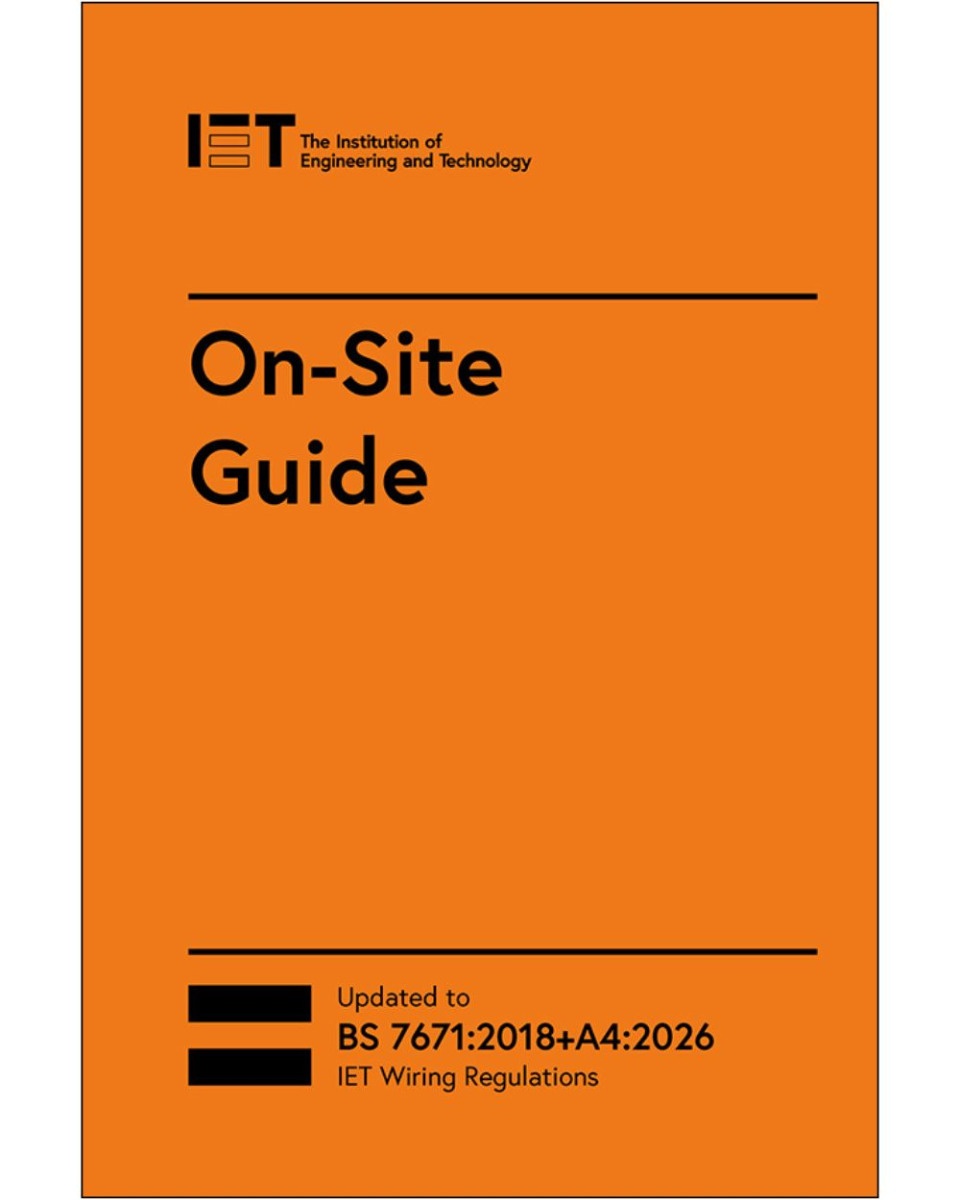
Amendment 4:2026 was published jointly by the IET and BSI on 15 April 2026 and can be worked to immediately. It's a consolidated document — meaning it folds Amendments 1 (2020), 2 (2022) and 3 (2024) into one single reference, plus adds genuinely new content of its own:
In short: if your job touches battery storage, solar PV, EV charging alongside other generation, structured data cabling, or a care home's medical areas, A4:2026 is the version you need to be working to — not the 2022 edition.

BS 7671:2018+A2:2022 introduced the thermal/fire and voltage disturbance protections, plus the first "Prosumer's Low Voltage Electrical Installations" chapter for properties that both generate and consume electricity (solar, battery storage, EV charging). Amendment 3:2024 followed with a narrower but important change: rules on bidirectional versus unidirectional protective devices for PV and battery systems. A4:2026 absorbs all of that and builds on it.
The old version — BS 7671:2018+A2:2022+A3:2024 — remains legally valid for site work until 15 October 2026, six months after A4:2026's release. After that date, A4:2026 is the only current standard.
No. Installations carried out and certified to an earlier edition of the Regulations aren't automatically non-compliant — the Regs aren't retrospective. What changes is the standard new work, alterations and EICRs get assessed against going forward. If you're a landlord or care home due a periodic EICR after October 2026, expect your electrician to be testing against A4:2026.
Every practising electrician and engineer, first and foremost — every Bright Spark electrician has their own. Property owners, landlords and facilities managers don't need to memorise the Regs, but knowing roughly what's changed helps when you're reading a quote or an EICR and want to understand why something's flagged.
The current edition is the On-Site Guide, 9th Edition (ISBN 978-1-83724-039-5), 256 pages, aligned to BS 7671:2018+A4:2026 — available direct from the IET Shop or trade counters such as CEF. Check current pricing there rather than relying on an old figure — the last edition was around £40, and cover price moves with each reprint.

Regulations move faster than most property owners realise — four amendments in six years. That's exactly why we keep every engineer's copy current and why our own testing, EICRs and installation work are carried out to whichever edition is legally in force on the day. It's also why it's worth using a NICEIC-registered contractor rather than an unregistered trader: registration requires us to demonstrate we're working to the current edition, amendment by amendment.
It's Amendment 4 (2026) to the 18th Edition of the IET Wiring Regulations — the current UK national standard for the design, installation and testing of electrical installations. It consolidates all four amendments and adds new requirements for battery storage, ICT bonding/PoE, and medical locations.
It was published on 15 April 2026 and can be used immediately. The previous version (A2:2022+A3:2024) is withdrawn on 15 October 2026.
Not automatically. Existing installations certified under an earlier edition aren't made unsafe or non-compliant by a new amendment. Your next scheduled EICR or any new work will simply be assessed against the current edition.
It adds guidance on bidirectional and unidirectional protective devices, stationary secondary batteries, updated maximum Zs values, and RCD and prospective fault current selection — all aligned to A4:2026.
It affects which standard the assessment is made against, not whether your existing certificate is still valid. See our guide to the Electrical Installation Certificate for what's actually recorded on one.
Direct from the IET Shop, or trade counters such as CEF. Avoid second-hand copies of superseded editions if you need to reference the current standard.
Electrical Installation Certificate
IET/BSI official press release, 15 April 2026
IET Shop — On-Site Guide, 9th Edition
IET — BS 7671 18th Edition hub
Not sure whether your home, rental property or care home is up to the current standard? Book a survey with a NICEIC-registered Bright Spark engineer and get a free, no-obligation quotation.
Book your free survey: Request a Quote | Call 01892 531728 | Email karen@brightsparkelectrician.co.uk

Karen and her team of "Bright Sparks" are wonderful to deal with and needless to say know their negatives from their positives with just a dash of earth . I would recommend their services to anybody.
I've used Electricians from Bright Spark 3 times to date , inc. a for a test certificate prior to buying my property. At all times the Electricians have provided a first class service with easy to understand advice and the work completed to a high standard. Many thanks to Karen and the Team.SC
Phil, from Bright Sparks arrived promptly, was really polite, cracked on with his job and gave us a really good brief on what he'd done and why it was needed which was then followed up with a thorough report. Bright Sparks have been absolutely superb and not only are they saved in my phone but also I'd recommend them to friends and family. Thanks guys. P.s. you were up front and transparent about costs too.
I was very pleased with the prompt and efficient service. The electrician phoned in advance to confirm his time of arrival and was friendly and polite.
I would like to thank Karen and Louise for their good work and considerate approach. I am very pleased and would recommend them for their efficiency and fair price.


